A new mixed-methods analysis of Compass Pathways’ COMP360 PTSD trial has reignited one of the most contentious debates in psychedelic medicine. How much does the drug actually need therapy to work?
The paper, published in the Journal of Psychopharmacology in 2026, analysed transcripts from a Phase 2 trial in which 22 participants received a 25 mg dose of COMP360. The researchers wanted to know what actually happens in the room during a dosing session.
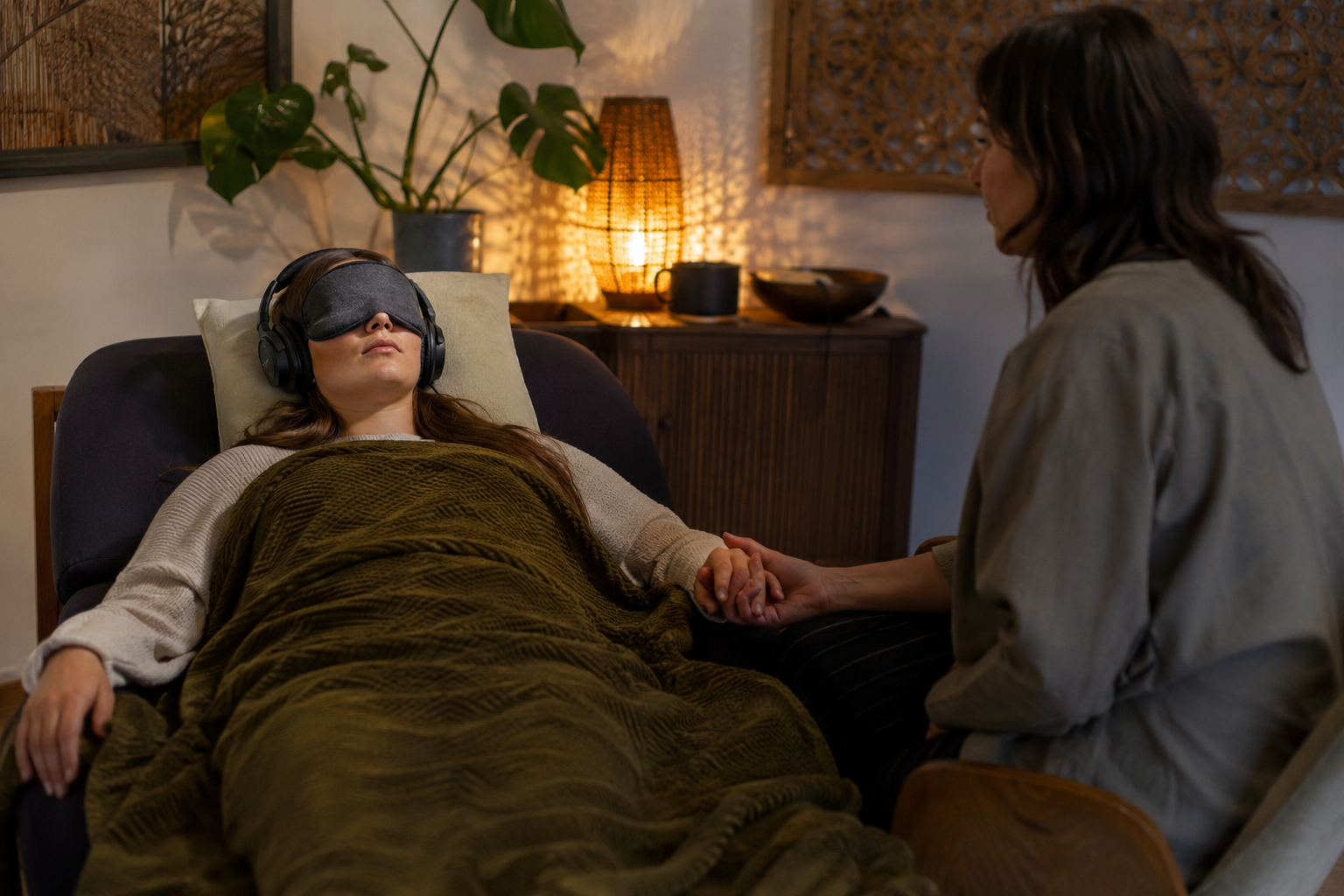
They found that participants spent the overwhelming majority of the session (around 78%) in silence. The support providers in the room spoke very little, and when they did, their role leaned toward presence rather than direction. Most participants described the experience of being monitored, held, and kept safe, rather than being actively guided through a psychotherapeutic process.
Commercial interests
Compass released a press release around these findings. The company explicitly states that it is incorrect to describe COMP360 as “psilocybin-assisted psychotherapy.” Instead, they’re drawing a hard line between monitoring and support (their model) and psychotherapy (a distinct clinical activity requiring specialist training, hours, and cost).
There’s an obvious incentive at play here. If a company can show regulators and payers that the drug works with structured monitoring alone, the treatment becomes cheaper to deliver, easier to standardize across sites, easier to train staff for, and dramatically easier to scale. Compare that to a model requiring 20 to 30 hours of specialist psychotherapy per patient, and the commercial gap becomes obvious.
This isn’t a new fight. Three broad camps have formed in the field over the past few years:
The drug-centric model treats psilocybin as the active ingredient, with psychological support existing mainly to manage safety, not to drive the therapeutic effect.
The therapy-centric model treats the drug as a temporary window, with the real change happening because of skilled psychotherapeutic work done before, during, and after the session.
The hybrid model, where most of the field currently sits, treats the drug-induced plasticity and the therapeutic relationship as inseparable, each shaping what the other can achieve.
The FDA’s recently finalised guidance leans toward acknowledging this complexity, calling for careful documentation of psychological support specifically because separating drug effects from therapeutic context is so difficult.
What the study doesn’t tell us
The transcript analysis only measured what happened during dosing sessions themselves. It says nothing about whether more therapist interaction would have improved outcomes, whether less would have hurt them, or whether preparation and integration work (which happens outside the dosing room) is actually where most of the durable change occurs.
It’s also worth noting that Compass has always used a fairly standardised, manualised model of psychological support rather than an individualised psychotherapy approach. That means these findings may say more about this specific protocol than about what an optimal support structure looks like for every patient.
There’s also a reading of the data that cuts against the “therapy isn’t needed” narrative entirely. Many participants described the facilitators’ minimal, undemonstrative presence as essential to feeling safe enough to stay immersed in the experience. Deciding when not to intervene, and holding a room steady while someone is in acute distress, is itself a clinical skill. Silence isn’t the same as absence.
Our read
This paper doesn’t prove that pharmaceutical companies are working to strip therapy out of psychedelic treatment. But it does fit a broader pattern of companies are trying to identify the minimum effective psychological support needed for safety and efficacy, standardise it, and make the treatment deliverable at scale. It’s not quite “therapy doesn’t matter,” even if it serves some of the same commercial goals.
The real unanswered question, the one that actually determines how psilocybin therapy should be built and reimbursed, is how much of the long-term benefit comes from the pharmacology itself versus the surrounding scaffolding of preparation, relationship, and integration. Different conditions, different compounds, and different patients may need very different ratios of the two. Nobody has that answer yet.
Sources
- Characterizing psychological support in COMP360 psilocybin treatment for PTSD: a mixed-methods analysis. Journal of Psychopharmacology (2026). journals.sagepub.com/doi/10.1177/02698811261464988
- Compass Pathways Announces Publication of Post-Hoc Analysis Demonstrating Distinction of COMP360 Trial Monitoring & Support from Psychotherapy. Compass Pathways press release. ir.compasspathways.com
- Kirlić, N. et al. Compass Psychological Support Model for COMP360 (2025). pubmed.ncbi.nlm.nih.gov/39741434
- COMP360 Phase 3 trial. ClinicalTrials.gov. clinicaltrials.gov/study/NCT05711940
Keep up with the research here.