Here’s a puzzle that’s bothered Alzheimer’s researchers for years. You can scan two brains, see the same amount of amyloid plaque and tau tangles in both, and one person is fine while the other is sliding into dementia. Researchers call this “cognitive resilience,” and up to now it’s mostly been chalked up to things like education, genetics, or how socially active someone stays as they age.
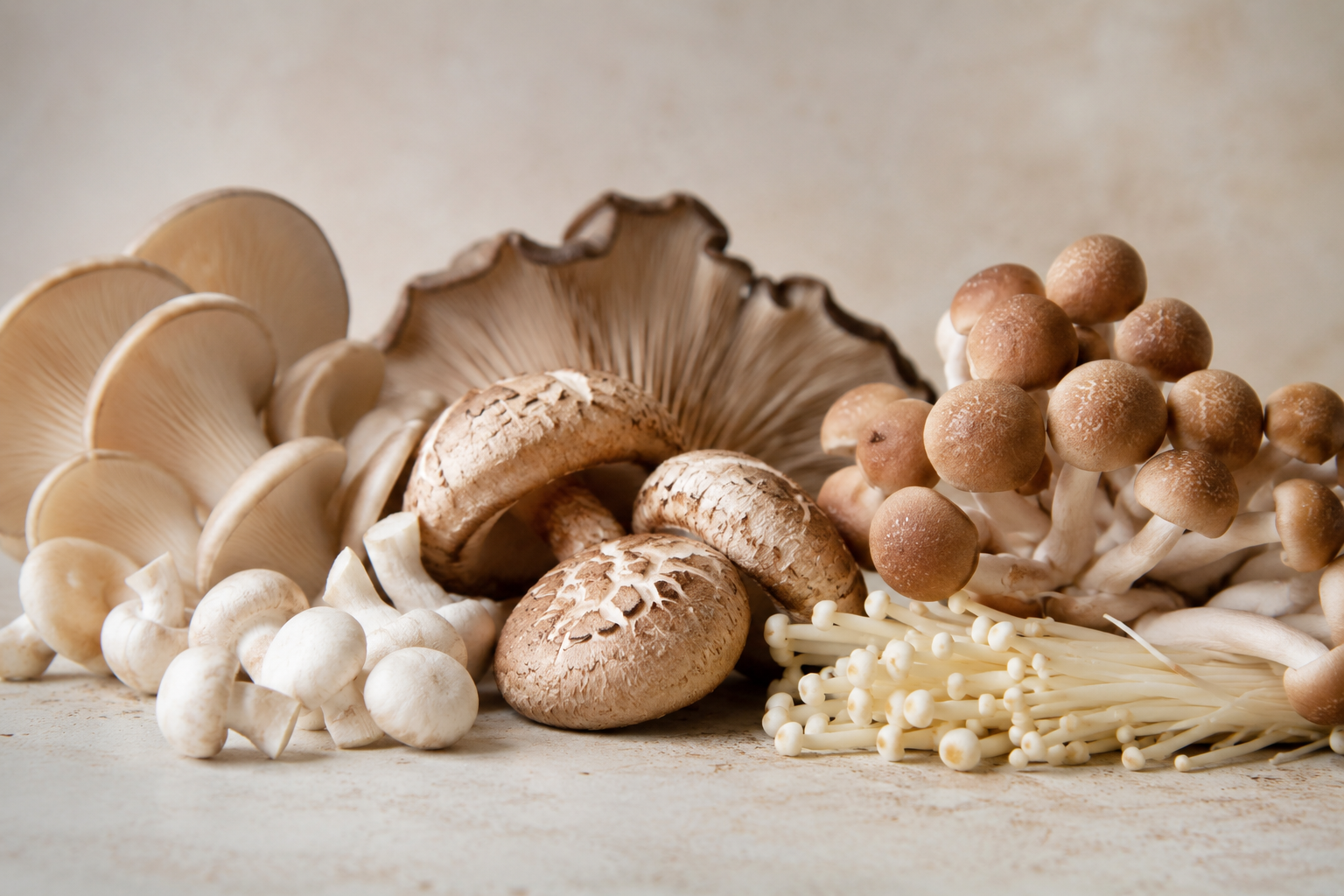
A new study out of Singapore adds something unexpected to that list: Ergothioneine – a compound found almost nowhere except mushrooms.
What they studied
Researchers at the National University of Singapore followed 259 people, none of whom had dementia at the start. They checked in on them every year for up to five years, tracking cognitive decline using a standard clinical scale.
At the start, they measured two things in each person’s blood. First, the usual markers doctors use to estimate how much amyloid pathology is building up in the brain (p-Tau181 and p-Tau217, if you want the names). Second, levels of L-ergothioneine, an antioxidant that the body can’t make on its own and has to get from food, mostly mushrooms, along with a byproduct called hercynine that shows up once ergothioneine has been used up doing its job mopping up cell damage.
That second measurement, the ratio of hercynine to ergothioneine, is basically a way of seeing how hard someone’s ergothioneine is working. A high ratio means a lot of it has been “spent.”
What they found
People with a lot of amyloid buildup and low hercynine-to-ergothioneine ratios had more than double the risk of declining cognitively compared to people with low amyloid. That’s the result you’d expect, more plaque, worse odds. But people with the same high amyloid burden and a high ratio? Their risk barely budged. Statistically, it wasn’t even significant anymore.
So the same amount of plaque, and a completely different outlook, depending on how much of this mushroom-derived antioxidant had been actively used up in their system. The pathology didn’t go away, but it seemed to matter less.
This is the first time anyone’s linked ergothioneine metabolism specifically, not just how much of it is floating around, to resilience against amyloid’s effects on the brain. It builds on earlier work from some of the same team, who’d already shown that people with dementia tend to have lower ergothioneine levels than people without it. This new study pushes that earlier, into the window before dementia sets in, when it might still be possible to do something about it.
It also lines up with something we covered here recently: a huge Nature Aging study that screened almost a thousand blood compounds against memory and brain scans in over a thousand middle-aged people, and found ergothioneine came out on top of the entire list. That study also matched the blood pattern seen in people with worse memory in midlife to the pattern seen years before an actual Alzheimer’s diagnosis, and the two lined up closely.
Ergothioneine is unusual. Humans can’t synthesize it ourselves, we’re entirely dependent on diet, and mushrooms are by far the best source there is, some species pack in dramatically more than anything else you’d eat. The body even has a dedicated transporter whose job is to grab ergothioneine from the blood and concentrate it in tissues, including the brain, especially when those tissues are under stress. That’s not the kind of thing evolution builds for a molecule with no purpose.
Why it’s worth paying attention to
This is a correlation, not proof. The study shows that people with efficient ergothioneine metabolism tend to do better despite amyloid pathology, but it can’t tell us for certain that the ergothioneine itself is causing that protection. It’s possible something else is going on that happens to move alongside it. The only way to really nail this down is a trial where people are given ergothioneine directly and researchers watch what happens to both the hercynine ratio and actual cognitive outcomes over time.
It’s also a fairly small study, 259 people, all from Singapore, so it needs to be repeated in other populations before anyone gets too excited.
Even with those caveats, this adds real weight to the idea that ergothioneine deserves to be studied seriously as something that might change the course of Alzheimer’s. The researchers themselves say ergothioneine should be tested directly as a way to counter amyloid-related decline. It’s cheap, it’s already in the food supply (although not as much as it used to be), and there’s now a plausible biological reason it might matter.
If you’re in the UK, buy ergothioneine here.
Keep up with the research here.