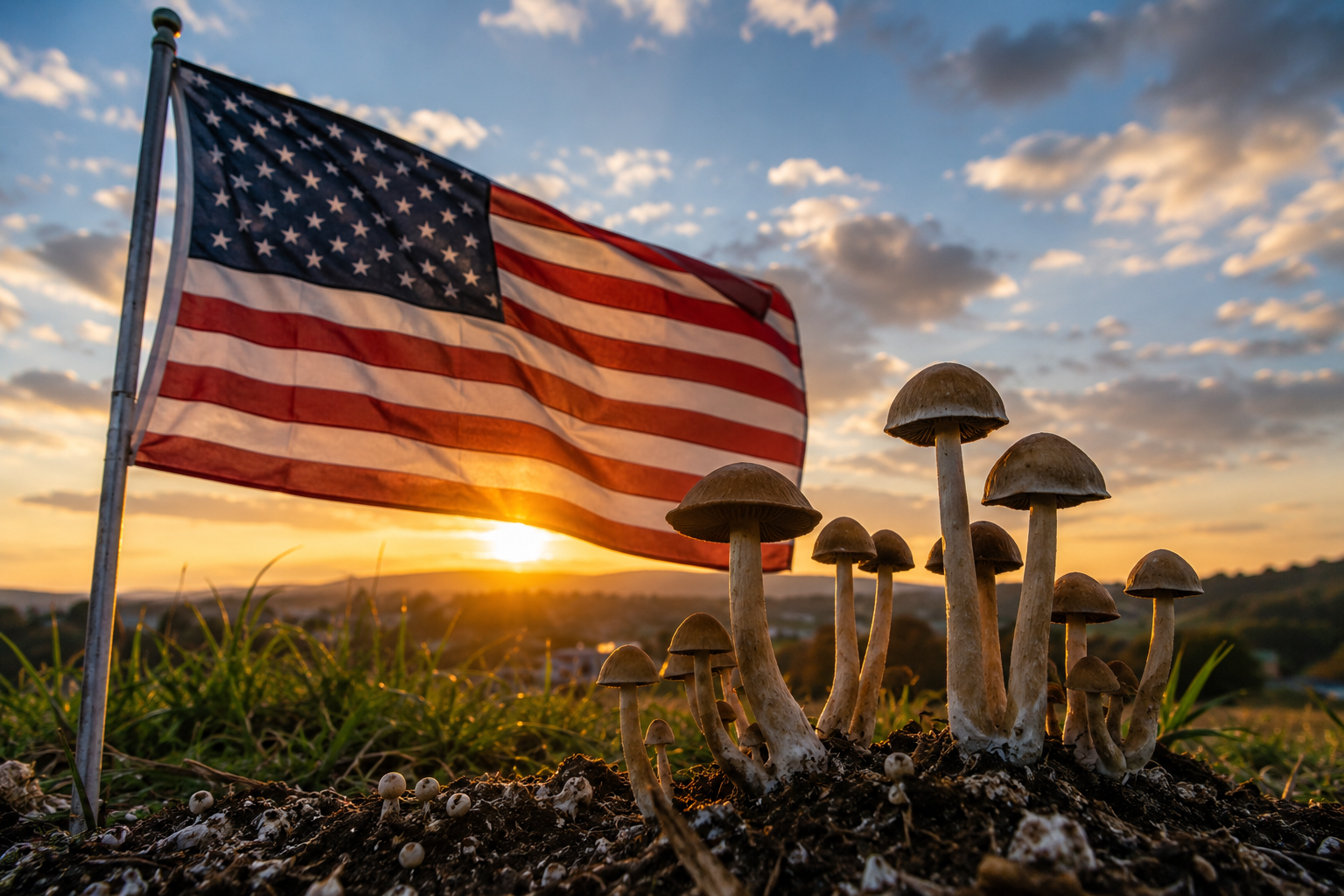
In 1966, long before psychedelic therapy entered mainstream medicine and decades before artificial intelligence became part of everyday life, a small group of scientists gathered in Menlo Park, California to answer a prescient question: could LSD help people think better.
The participants were engineers, architects, mathematicians and physicists who came with technical problems and challenges from their professional lives that hey had been wrestling with for months or years. Under carefully structured conditions, they were given LSD and invited to explore those problems.
What happened next was mind blowing. According to the published study, many participants experienced genuine breakthroughs. Several reported solutions that later became patents, scientific papers or commercial products. The paper, Psychedelic Agents in Creative Problem-Solving, published by psychologists Willis Harman and James Fadiman, hinted at an extraordinary possibility. Perhaps psychedelics weren’t only medicines, but tools for expanding human creativity and discovery.
Then, almost as quickly as the dust had settled on the breakthrough, history intervened. As the political backlash against psychedelics intensified in the late 1960s, LSD became a Schedule I substance in the United States. Funding evaporated and research programs were shut down across the world. Harman and Fadiman’s experiment faded into obscurity, becoming one of those tantalizing “what if?” moments in the history of psychedelic science.
For nearly sixty years, that remained the case. Until now.
A Modern Sequel
This November, in Peru’s Sacred Valley, an organisation called Neuraversa will bring together 18 scientists and researchers for a two-week program designed to revisit the original question using the tools of the twenty-first century. Participants will take part in three to five guided ceremonies involving psilocybin, ayahuasca, San Pedro and 5-MeO-DMT, working within traditional Shipibo frameworks while simultaneously developing their research alongside bespoke AI systems designed to support scientific thinking.
The project is being led by Dawid Rakowski, a psychedelic historian, guide and facilitator who has spent years living in Peru studying psychoactive plants and the cultures that have worked with them for generations. Rather than treating psychedelics as isolated chemicals, Rakowski approaches them within their broader historical and cultural context, seeing indigenous knowledge as an essential part of understanding these compounds.
His ambition isn’t simply to recreate the Harman study. Instead, Neuraversa asks an updated questio: what happens when experienced researchers spend two weeks immersed in altered states, supported by traditional ceremonial practice and artificial intelligence capable of organizing information, generating hypotheses and acting as an ever-present research partner?
When Harman conducted his study in 1966, participants left their sessions carrying little more than notebooks filled with hastily scribbled observations. Today, ideas can be captured, expanded, challenged and refined almost instantly. A language model can retrieve relevant literature in seconds, connect seemingly unrelated fields, identify gaps in reasoning and help transform fragments of insight into coherent research questions before they disappear into memory.
Read: Can magic mushrooms make you smarter?
Psychedelics may temporarily loosen rigid patterns of thinking, making it easier to see problems from unfamiliar perspectives. AI, meanwhile, excels at organizing complexity, recalling information and exploring possibilities at a scale no individual mind can manage alone. One tool may help generate novel perspectives; the other may help determine whether those perspectives actually hold up.
Now, this isn’t a randomized controlled trial, and it won’t produce definitive evidence about whether psychedelics enhance scientific creativity. The participant group is small and highly selected, multiple compounds are involved, and the ceremonial setting introduces countless variables that would be difficult to disentangle experimentally. Any breakthroughs that emerge will still need to survive the same scrutiny, replication and peer review expected of any scientific idea. Yet that doesn’t make the experiment any less compelling.
The Next Frontier
Much of the current psychedelic renaissance has understandably focused on healing. Clinical trials have explored depression, addiction, PTSD and end-of-life anxiety, offering promising evidence that these compounds have profound therapeutic potential.
But buyond medicine, anyone who’s tried these compounds knows can have powerful effects of cognition, perspective, problem solving, and consciouness itself. Another frontier begins to emerge.
This broader question feels especially relevant now because artificial intelligence is already reshaping the way science happens. Researchers increasingly think with search engines, large language models, simulations and digital collaborators. Human cognition is becoming distributed across biological and technological systems in ways that would have seemed like science fiction only a decade ago.
Whether it ultimately produces groundbreaking discoveries or simply makes a good story remains to be seen.
Check out their website here: https://www.neuraversa.org/
Keep up with the research here: https://www.thesporereport.co.uk/