A new mouse study found that psilocybin switches on the same genes in the visual brain that light normally switches on, even when the room is completely dark.
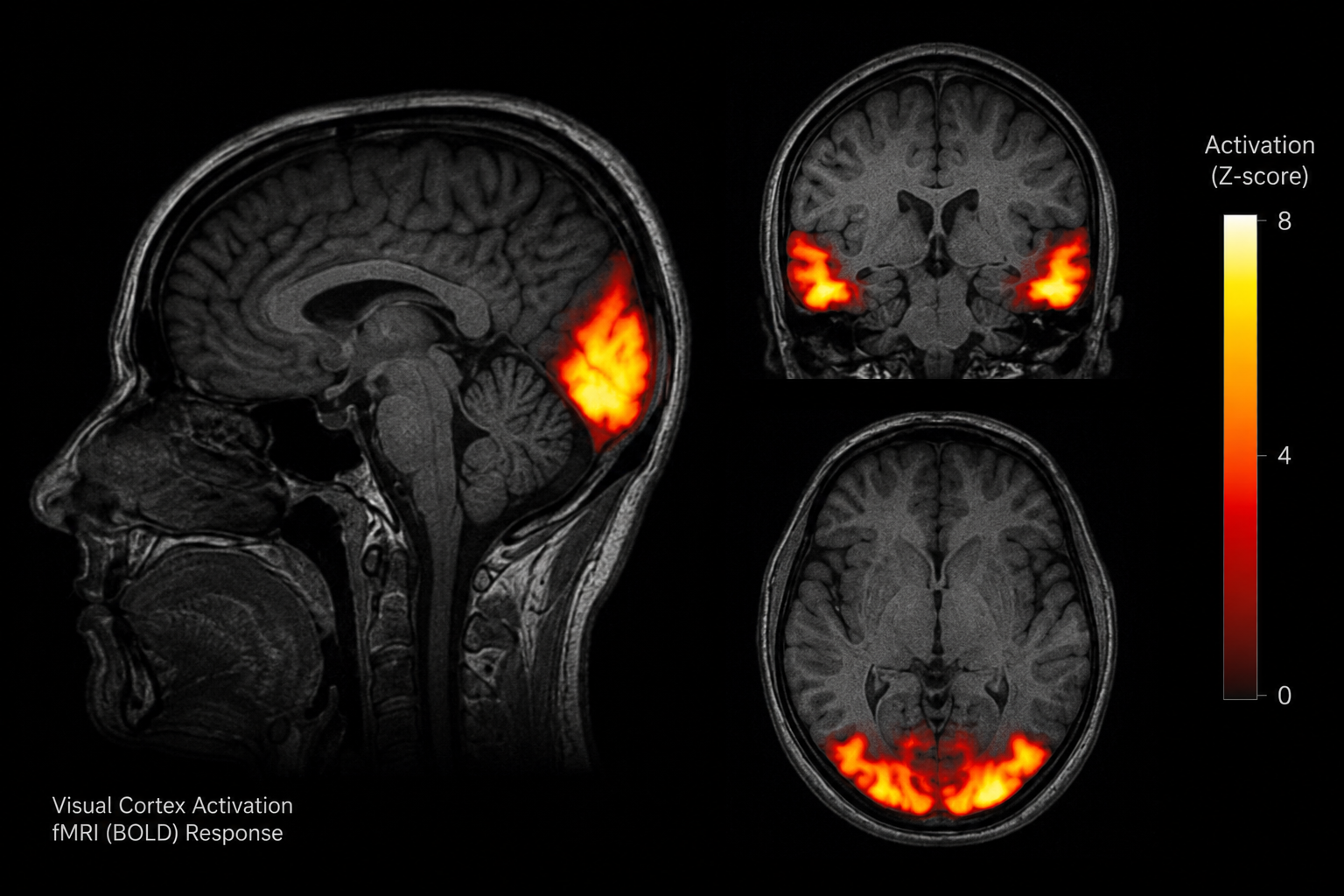
Researchers gave mice psilocybin and looked closely at what happened inside their visual cortex, the part of the brain that processes sight. Unexpected, they found psilocybin triggered widespread changes in gene activity there, and those changes closely resembled what normally happens when the eyes are flooded with light.
The catch is that the mice were kept in total darkness the entire time. There was no light to process, and yet, at the molecular level, their visual brains behaved almost exactly as if they were looking at something. The overlap was substantial: roughly 77% of the genes altered by psilocybin were the same genes altered by actual light exposure.
This is a mouse study, so we can’t yet be sure the same thing plays out inside a human brain on psilocybin, or that it fully explains the vivid visuals people describe during a trip. But it does suggest that psilocybin may flip the same molecular switches inside the visual brain that real light flips, without needing any actual light to do it.
How Light Normally Works in the Brain
To understand why that’s such a strange finding, it helps to know what light actually does inside your head.
When light hits your eyes, it lands on the retina, a thin layer of cells at the back of the eye that works like a translator. Its job is to convert light into an electrical signal your brain can use. That signal travels down the optic nerve and arrives at the visual cortex, where it gets turned into the actual experience of seeing colour, shape, and movement.
Here’s the part most people never learn. Arriving light doesn’t just get processed and forgotten. It switches things on inside the cells of the visual cortex. It activates certain genes, the molecular instructions inside each brain cell that control what that cell builds and how it behaves. In plain terms, light actively reshapes the wiring of the part of your brain doing the seeing, a little, every time you look at something.
That’s the system psilocybin appears to be triggering, without any light involved at all.
The Genes Involved
The specific genes that lit up under psilocybin weren’t random. Several of them (Arc, Egr1, FosB, and Npas4, if you want the names) belong to a category researchers call immediate early genes. The name just describes what they do. They switch on fast, within minutes, whenever a neuron is in the middle of learning, adapting, or rewiring itself.
You can think of them as an internal alert system. Their job is essentially to say: something important is happening here, pay attention, change accordingly. They’re heavily involved in memory formation, in strengthening the connections between brain cells, and in the broader process scientists call neuroplasticity, which is just the brain’s capacity to physically reshape itself in response to experience.
So when these genes switch on under psilocybin, in the dark, with no actual visual input arriving, it suggests the visual cortex is doing something it normally only does when it’s genuinely learning from the world.
Loosening the Brain’s Usual Filters
There’s a second layer to this. The study found that psilocybin increased activity-related genes in one type of neuron (the excitatory kind, which pushes other neurons toward firing) while decreasing them in another type (the inhibitory kind, whose job is normally to hold activity back and keep things in check).
That’s roughly the picture researchers have built around psychedelics more broadly, called the Entropic Brain Hypothesis. The idea is that psychedelics loosen some of the brain’s usual filtering and gatekeeping, making perception less constrained and more sensitive to subtle patterns. This study gives that idea a concrete molecular face inside the visual system specifically.
The Light-Plus-Psilocybin Synergy
When mice received psilocybin and actual light exposure together, the researchers found a distinct set of changes that neither one produced alone. These involved genes (CREBBP, HDAC5, and TOP1, among others) that don’t just respond to the moment. Their job is to help determine which other genes will be available to switch on in the future. They’re part of the machinery that governs long-term learning capacity itself.
In other words: psilocybin combined with real experience appears capable of adjusting the brain’s future learning machinery.
This lines up with something that’s become a working idea in psychedelic therapy circles. The drug itself may not be the treatment. The experience that happens during the drug state, and how meaningfully the brain encodes it, may be the actual treatment. If psilocybin makes the brain unusually receptive to whatever is happening around a person at the time, then the conversation in the room, the music playing, time spent in nature, a moment of emotional breakthrough, none of that is incidental.
It may be getting biologically written into the brain’s future operating instructions in a way that wouldn’t happen on an ordinary day. That would help explain why things like felt mystical experience, a strong sense of connection to a therapist, and careful integration afterward all consistently predict better outcomes in psychedelic therapy research.
The Philosophy Of “Light”
Humans have been describing psychedelic and mystical experiences using the language of light for as long as we’ve been writing anything down.
Plato’s escaped prisoner walks out into the sun, as the sun is the source of all real knowledge. Christianity hands us “I am the light of the world.” Buddhism’s whole destination is called enlightenment. Alchemical tradition associates enlightenment itself with the sun. Carl Jung described the moment something hidden in a person’s unconscious finally becomes clear as that material being lit up.
Across all of it, the pattern repeats. To understand something is to see it.
So when a study finds that the chemical most associated with insight and revelation switches on the same genes that actual light switches on, inside the exact part of the brain built to process light, it’s hard not to see a deeper connection.
What This Might Mean
One useful way to think about this comes from cognitive scientist Donald Hoffman. He argues that ordinary perception was never built to show us the world exactly as it is. It was built for survival, which means your eyes and brain hand you a simplified version of reality, closer to the icons on a desktop than to the code running underneath.
If he’s right, a psychedelic state might not be revealing some ultimate truth out there in the universe. It might be loosening the simplified version your brain normally hands you, letting through details and patterns that were always present but usually filtered out. That fits how people actually talk about these experiences. They rarely say “I learned something brand new.” They almost always say some version of “I finally saw what was already there.”
Put another way, the visual cortex may not particularly care whether the signal telling it something meaningful is happening arrives as actual photons or as a profound internal experience. Both appear able to flip on a similar program of perception and adaptation.
The Takeaway
None of this proves psilocybin reveals ultimate reality. What we actually have is a fascinating molecular finding in mice, a very old habit of describing insight as light, and an open question about what that means.
Most explanations for how psilocybin works focus on serotonin receptors or changes in how different brain networks talk to each other. This study suggests psilocybin may temporarily place parts of the brain into an experience-ready state, a state where perception becomes more flexible, learning becomes easier, meaning becomes amplified, and ordinary experience becomes biologically potent.
If that’s right, then psychedelics may be compounds that temporarily convince the brain it’s encountering something worth rewiring itself around.
It’s worth taking that seriously. Preparing for the experience matters. Having the right set and setting matters. And what happens in the days and weeks afterward, while the brain is unusually receptive to what it’s handed, matters just as much as the experience itself.
That’s exactly what AfterGrow is built around. 6 weeks of structured support to help you actually metabolise a psychedelic experience into lasting change. Enrollment closes Friday, June 26th, and the program starts July 1st. Join AfterGrow here.
Want more breakdowns like this one? Subscribe to The Spore Report here.
Source: The psychedelic psilocybin and light exposure have similar and synergistic effects on gene expression patterns in the visual cortex. Ram Harari et al. 2025 Mar 18;18:23. doi: 10.1186/s13041-025-01191-0