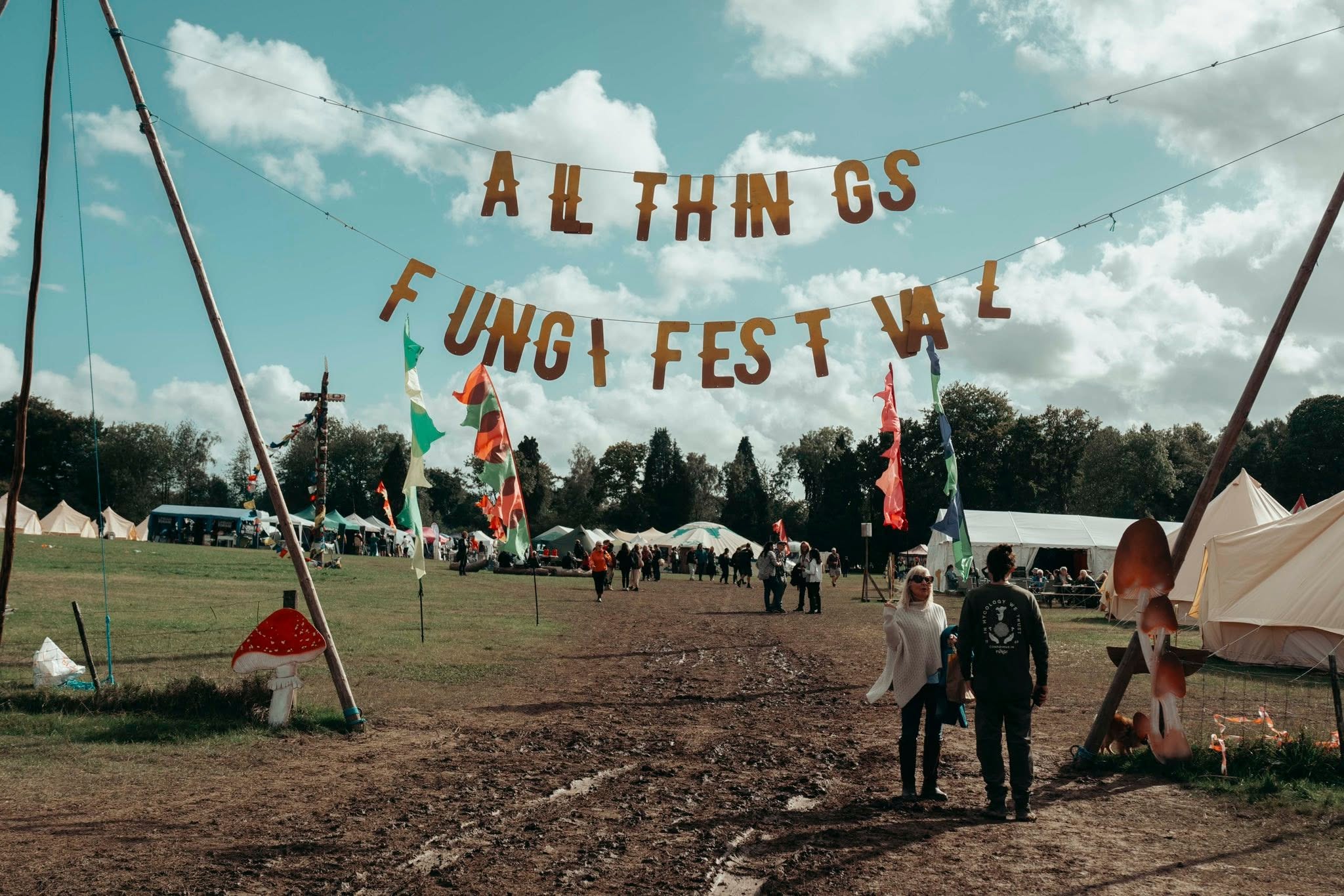
If you’ve ever wished there was a festival that took mushrooms as seriously as it took live music, your wish has been granted. The All Things Fungi Festival returns to West Sussex this September, and it’s shaping up to be the best celebration of Kingdom Fungi the UK has seen.
What it is
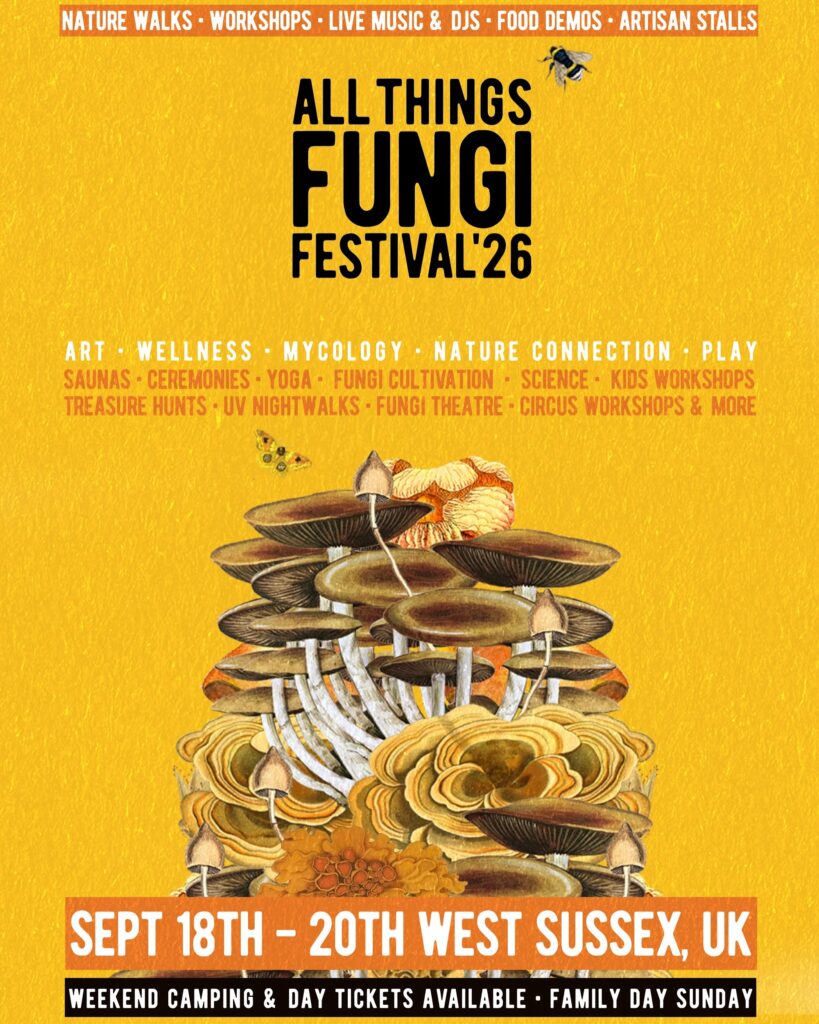
All Things Fungi bills itself as the UK’s first dedicated mushroom festival, a three-day immersion in fungal culture, science, and ecology. It takes place September 18-20, 2026, at Chiddinglye Estate, a private rural site in the High Weald near East Grinstead, West Sussex. Think ancient woodland, open meadow, and forest trails that double as an active foraging ground, since part of the estate is officially recognised for its scientific importance.
The festival keeps things intentionally small. With a capacity of around 600 people, it’s more like a gathering of the converted than a mass-market event. It’s the kind of place where you might actually end up talking mycelium networks with the person who literally wrote the paper on it.
Where art meets science
The tagline “where art meets science” isn’t just branding. The programme spans:
- Mushroom identification and foraging walks led by experienced mycologists
- Cultivation workshops, for anyone wanting to grow their own
- Microscopy and DNA sequencing demonstrations
- Talks on the soil food web, composting, permaculture, and fungal conservation
- UV night walks through the estate’s dark-sky woodland (this is the one we’d circle on the schedule)
- Live music, art installations, and a “secret woodland stage”
- Daily wellness sessions, yoga and breathwork, before the talks begin
It’s a rare event that puts soil health and mental wellness on the same bill, which is pretty fitting considering fungi are the connective tissue between ecosystem health and human health.
Who’s on the bill?
The 2026 lineup reads like a who’s-who of UK mycology, with dozens of researchers, growers, artists, and educators confirmed so far. Two names worth flagging for the science-minded:
- Professor Lynne Boddy, a decomposition and fungal ecologist who has spent decades studying how woodland fungi interact, compete, and move nutrients through forest ecosystems. Her work on the foraging behaviour and network architecture of wood-decaying fungi is some of the foundational research behind the “fungal networks” framing you’ll see everywhere now, and she’s currently looking at decay communities inside veteran trees and the impact of ash dieback and climate change.
- Dr. Sam Gandy, an ecologist, cultivator, and science communicator whose research sits at the intersection of psychedelics and our relationship with nature. He’s worked with the Beckley Foundation, the Synthesis Institute, and Imperial College London’s Centre for Psychedelic Research, and runs cultivation workshops covering liquid culture techniques for growers wanting to go beyond the basics.
That’s two names out of a packed roster, so it’s worth browsing the full lineup yourself, more contributors are still being announced.
Why it matters to us
We talk a lot here about the brain and body as living ecosystems rather than machines, and about mycelium as the governing metaphor for that idea. A festival built entirely around fungal networks, decomposition, and regeneration is basically a live-action version of that thinking. Whether you’re there for the DNA sequencing demo or the UV forest walk, the underlying message is the same one we keep returning to: nothing in a healthy system works alone, and fungi are the clearest proof of that we have.
It’s also, frankly, a sign of where the culture is heading. Mycology has spent decades as a niche interest for foragers and lab researchers. The growing popularity of events like this suggests that’s shifting, and that public appetite for fungi (as food, as medicine, as ecological infrastructure) is catching up to the science.
The practical details
A few things worth knowing before you book:
- Camping required. This is a bring-your-own-tent event, and nights in the Sussex woods get cold, so pack accordingly.
- No alcohol sold on-site.
- Adults-first event. Children under 18 are only permitted on-site (accompanied by an adult) on the Sunday.
- Tickets release in phases (Early Bird, General Release, Final Release), with prices rising as the date approaches, so earlier is cheaper.
- Pricing. According to UK festival listing sites, tickets span roughly £40 to £195 depending on type, with weekend adult passes, concession and two-for-one carer rates, single-day tickets, and a free entry option for under-5s on the family day. Vehicle and campervan passes are sold separately.
- No animals allowed, and ID is checked at the gate for concessions and age-restricted entry.
Tickets are available through the festival’s official tickets page, with a published lineup that organisers note may shift as the date gets closer.
Or, skip the tent shopping entirely
There’s also a glamping raffle running ahead of the festival, and it’s worth a look even if you’ve already got your tickets sorted. One winner takes home a package worth over £800: festival tickets for two, a furnished bell tent, a hot meal each day of the event, and weekend parking (or a live-in vehicle spot if that’s more your style). Entries are £2 each.
If you’ve already bought tickets and end up winning, you’re not out of luck either, organisers will refund your previously purchased tickets to the value of the prize, excluding fees.
A portion of the proceeds goes to iNaturalist, supporting the citizen science platform behind so much of the fungi and wildlife recording community relies on, which feels fitting for an event built on exactly that kind of grassroots documentation.
See you there!
If you find yourself being drawn to learn to learn more about fungi, this is about as immersive an introduction to the wider kingdom as you’ll find anywhere in the UK. And if you’re already deep into mycology, it’s a chance to be in a field (literally) with several hundred people who find this stuff just as fascinating as you do.
Either way, I hope to see you there!