
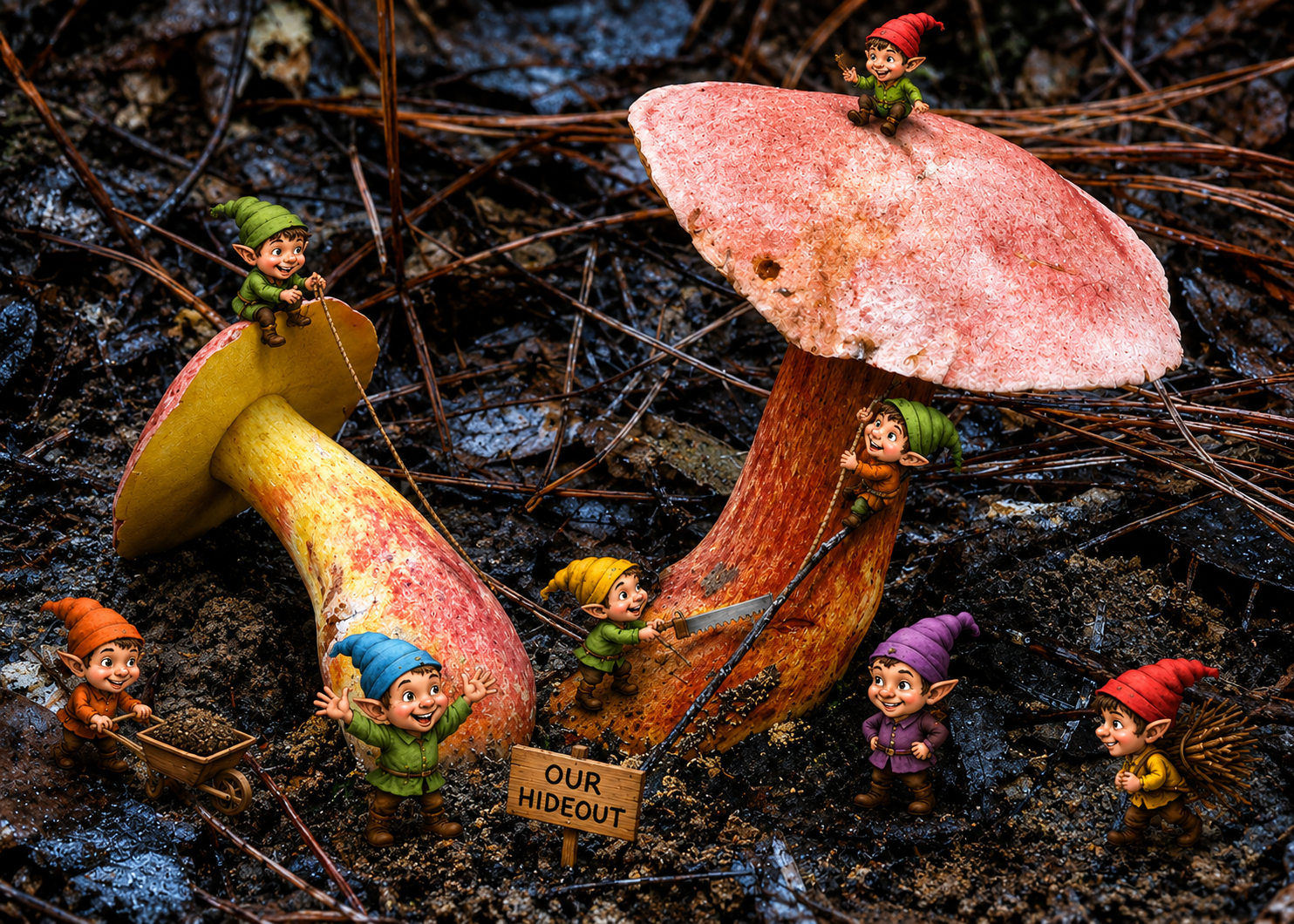
What’s the deal with mushrooms and elves?
A few moths ago a researcher published his findings on a mysterious mushroom that reliably produces lilliputian hallucinations when eaten raw. I was one of the first to report on it, and countless publications have since.
However, there’s been very little development on what the hell is actually going on with this mushroom – like why does it cause these halluciantions, what’s the chemical responsible, and do any of its close relatives also have the same effect?
When looking for answers to these questions, I came across a fascinating article by Dr David Luke, Professor of Exceptional Experience at the University of Greenwich, who has spent decades at the intersection of psychedelic science, anthropology, and what he calls “exceptional human experience.” His piece sent me down a wondrous rabbit hole and it opened my mind to how much we still don’t know about the fungi kingdom, the brain, and… elves.
Life is far stranger and more diverse than I ever imagined. And Lanmaoa asiatica – the tiny-person-producing bolete mushroom from Yunnan, China – is proof of that.
The Mushroom That Reveals Armies Under Your Tablecloth
Lanmaoa asiatica has been used as a wild culinary mushroom in Yunnan for generations, where locals call it Jian shou qing. When cooked properly, it’s apparently delicious. When eaten undercooked or raw, something rather different happens.
Locals have long known about it. The mushrooms, when eaten raw, cause visions of tiny people marching like soldiers – called xiao ren ren, or “little people.” Luke recounts a story that captures it perfectly: a professor from Yunnan, aware of the mushroom’s reputation, ate some and waited for the little people to appear. But nothing happened. Disappointed, he lifted the tablecloth, and lo and behold found hundreds of xiao ren ren, marching in formation underneath.
Reports of “mushroom madness” following consumption of similar fungi in Papua New Guinea go back to anthropological literature from 1934, with what was called ‘nonda’ fungi. And L. asiatica itself was only formally described and named in 2015.
The hospitalisation data says that somewhere between 69% and 91% of people hospitalised after eating these mushrooms report hallucinations, with no fatalities and no abnormal vital signs recorded. The body, it seems, tolerates whatever this is remarkably well. The mind is another matter.
A Compound We Haven’t Identified Yet
The scientific puzzle at the centre of all this is that nobody knows what’s causing it. A research team at the University of Utah, led by doctoral student Colin Domnauer under expert mycologist Professor Bryn Dentinger, has been working to identify the active compounds.
They’ve ruled out the obvious candidates like psilocybin and psilocin (from Psilocybe species) and muscimol (from Amanita muscaria). Whatever is producing these visions is chemically distinct from anything we’ve characterised before.
A team from the Chinese Academy of Tropical Agricultural Sciences has identified 20 different compounds in L. asiatica so far, including four entirely new ones. But no one has yet done what Luke describes as the “heroic (or reckless)” self-experimentation that Albert Hofmann used to identify psilocybin, or Arthur Heffter used with mescaline. Someone, at some point, is going to have to try these compounds themselves to find the one hiding the little people – which is traditionally how psychedelic science actually works at the frontier.
Not Just a Mushroom Thing
What makes Luke’s article particularly interesting is the wider pattern he traces. The xiao ren ren aren’t unique to L. asiatica. Reports of tiny beings (elves, pixies, dwarves, gnomes, soldiers) appear across a surprisingly wide range of psychedelic experiences.
DMT is the most discussed. Terence McKenna famously declared: “You get elves, everybody does.” The data is more nuanced. Survey research across around 2,500 people reporting entity encounters with DMT found that only 14-27% reported encounters with little people specifically. Luke’s own field research, observing people taking high-dose DMT directly, found the figure closer to 3%. The little folk, as he drily puts it, “just don’t like being watched.”
But the phenomenon also appears with ayahuasca, peyote, and according to Luke’s own account, with Brugmansia (floripondio) – the delirious, anticholinergic plant in the Datura family. At a parapsychology conference in Brazil in 2010, Luke and a group of colleagues appear to have been unknowingly dosed with it. His account of the subsequent minibus journey is one of the stranger pieces of experiential reporting I’ve read in psychedelic literature.
The appearance of tiny beings across such a pharmacologically diverse set of substances is something that neither mainstream neuroscience nor psychedelic science has really gotten to grips with. Is there a specific neural signature that generates “miniaturised human-like entity” as a hallucination category? Is there something in the structure of certain altered states that the human perceptual system resolves into the little people? We don’t know.
Why This Matters for the Broader Field
From a mycological standpoint, L. asiatica is a reminder that the psilocybin conversation, as important as it is, represents a tiny slice of what fungi are doing chemically. Luke draws an interesting parallel: Pochonia chlamydosporia, a worm-hunting fungus, produces ketamine. Periglandula clandestina, an endophyte infecting morning glory seeds, produces lysergic acid. These are evidence of a kingdom that has been synthesising neuroactive compounds far longer than we’ve been studying them.
The Lilliputian mushroom is probably not going to become a clinical intervention. The visions it produces are fascinating but not exactly controlled, the compound is so far unidentified, and the dose-response is unclear. But it still an important mystery to solve because it expands the map.
Every new psychoactive compound from the fungal kingdom is a new data point. A new key that might eventually unlock something about how consciousness works, how the brain constructs reality, and why human minds across cultures and centuries keep populating their altered states with the same cast of tiny, mischievous beings.
The Pattern That Won’t Go Away
Humans have been encountering “the little people” for as long as we have records. Tylwyth Teg in Wales, Tír na nÓg in Celtic mythology, xiao ren ren in Yunnan, the Guaraní spirits of Brazil, pixies, elves and fairies just to name a few. These encounters happen in ceremony, in dreams, in illness, in psychedelic experiences, and occasionally in ordinary life.
There are connections running beneath the surface of these reports that we haven’t fully mapped yet. The fungal kingdom and the human nervous system have been in relationship for a very long time. Whatever L. asiatica is doing, it’s tapping into something old.
Luke closes his piece with a reference to Tír na nÓg (the mythic Celtic land of the little people) and an open question: when we eventually identify the compound, understand the neural mechanism, and replicate the effect in controlled conditions, will we be closer to understanding why human consciousness generates this particular hallucination?
Or will the little people just scatter back under the tablecloth?
If this kind of thing interests you sign up for our newsletter here.
And if you haven’t read David Luke’s original piece, it’s well worth your time. The man has been in more bizarre situations in service of psychedelic research than almost anyone else in the field and he writes about them with a kind of cheerful empiricism that I deeply respect.


I’ve done mushrooms dozens of times at every range of dose from micro to double-heroic and have literally never seen a tiny person or elf.