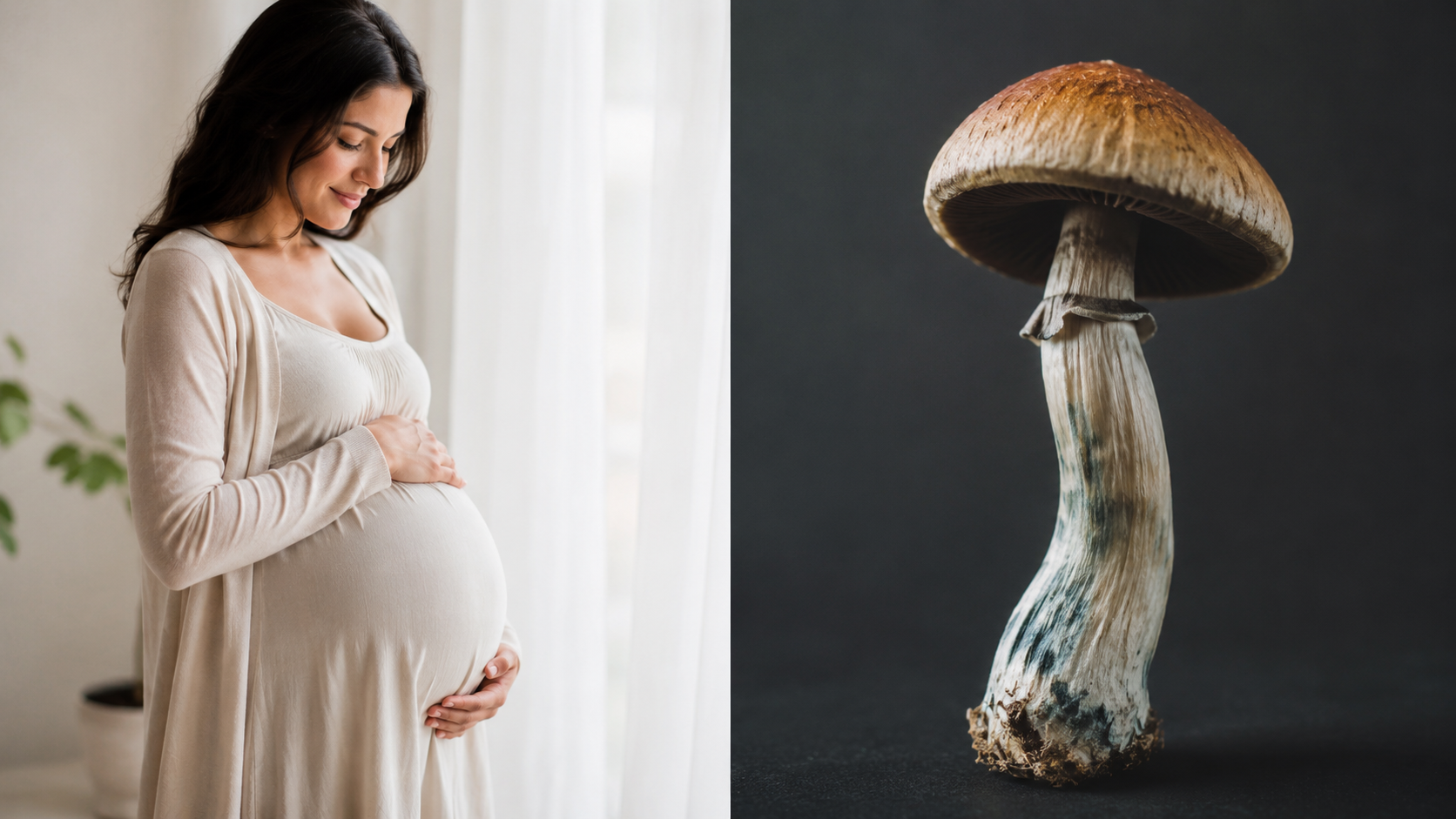
Psilocybin is transforming mental health treatment. But for pregnant and breastfeeding women, the science is almost entirely absent.
The Research Gap
Every major clinical trial studying psilocybin excludes pregnant participants. On paper, this looks like caution. But in practice, it means we have almost nothing to go on. Women are being left to make high-stakes decisions in the dark.
This means that no human studies have been conducted to assess whether psilocybin increases the risk of birth defects or pregnancy complications. A single animal study confirmed that psilocybin crosses the placental barrier and accumulates in fetal tissue in rats. Whether this holds in humans, and what the downstream effects might be, remains unstudied. Because psilocybin interacts with serotonin receptors, and serotonin plays a role in fetal brain development, there are legitimate theoretical grounds for caution. But theoretical grounds are not data.
The current scientific position, put plainly by researchers who study this area, is: we don’t know if it’s safe, therefore assume it isn’t until proven otherwise. That’s a defensible position. It’s also one that leaves people navigating crises without meaningful guidance.
What The Animal Research Is Telling Us
Two pieces of animal research deserve attention, and they point in different directions depending on the question being asked.
The first, older finding is that psilocybin crosses the placental barrier in rats and concentrates in fetal tissue. This has been known for some time and is one reason the “we don’t know” warning exists at all.
The second is more recent. In October 2025, a team from UC Davis’s Institute for Psychedelics and Neurotherapeutics published a paper in Nature Communications that found psilocybin may carry specific risks not just during pregnancy but in the postpartum period. Mouse mothers dosed with psilocybin showed amplified anxiety and depressive-like symptoms.
Worse, those effects didn’t stay with the mothers. Offspring raised by psilocybin-treated mothers developed measurable anxiety and depressive traits well into adulthood. Their brains showed traces of psilocin, the active metabolite of psilocybin, suggesting the compound passed to pups via lactation and had a lasting impact on neurodevelopment.
“Even low doses of exposure can impact offspring for long periods of time,” said study co-author Danielle Stolzenberg, an associate professor of psychology at UC Davis.
The lead researcher, David Olson, was careful to contextualise the finding: “These could be really important therapeutics, but we also realise they have limitations, and we have to conduct rigorous science to understand what those limitations are.”
Critically, the researchers flagged that ovarian hormone context appears to change how psychedelics act in the brain (somethign we recently reported on). The neuroplasticity mechanisms that make psilocybin so promising in standard populations may behave differently in the hormonal environment of pregnancy and early motherhood. This is a fundamental variable that the field has barely begun to account for.
The Community Research Filling The Gap
Because science has largely left this question unanswered, others have stepped in.
Mikaela de la Myco (a California-based advocate with Indigenous Mexican heritage and over 200,000 social media followers) used psilocybin throughout her own pregnancy, citing both cultural tradition and a need to manage trauma and alcohol dependency. After the birth of her son, she began documenting the experiences of others. In partnership with a UK-based doula, she distributed a survey across her networks and collected responses from 178 people who used psilocybin during pregnancy and 237 who used it while breastfeeding.
The project, released as a community research paper in 2025, represents one of the largest collections of experiential data on psilocybin and pregnancy assembled to date. A majority of respondents reported positive subjective outcomes, including reduced depression, better emotional regulation, and stronger connection with their children. Many explicitly described preferring psilocybin over pharmaceutical alternatives they considered less natural or more risky.
The work is earnest and the data is valuable as a starting point. But the scientific criticisms are also legitimate. The survey draws from a self-selecting network of committed psychedelic advocates, doesn’t control for other health behaviours, and birth outcome data was only gathered from 14 participants. You can’t draw clinical conclusions from that.
What the project does well is highlight the issue, which is more useful than pretending the question doesn’t exist because it’s uncomfortable.
Indigenous Knowledge
Stacy Schaefer, professor emerita in anthropology at California State University Chico, has documented the Wixárika, an Indigenous Mexican community, using peyote during pregnancy for generations – including to ease labour pain and support lactation. Brazilian women in the Santo Daime and União do Vegetal churches regularly consume ayahuasca during pregnancy.
These are communities with multigenerational frameworks for using plant medicines in contexts, including pregnancy, that western medicine refuses to study.
None of this constitutes proof of safety by modern scientific standards. But it does mean the question of psychedelics during pregnancy isn’t being asked for the first time in 2025. It’s being asked again, in a new language, after a very long institutional silence.
Where This Leaves Us
Here is the honest picture as it stands:
There is no human evidence that psilocybin is safe during pregnancy or breastfeeding. There is also no human evidence that it causes harm. Absence of data in both directions means the precautionary default applies, and the scientific consensus position remains that it’s not safe until demonstrated otherwise.
The most recent animal data adds a specific layer of concern around the postpartum period. The finding that psilocybin may worsen rather than relieve perinatal mood disorders, and that effects may pass to offspring via breastfeeding, is significant enough to take seriously even accounting for the species gap.
At the same time, the mental health crisis facing pregnant and postpartum women is real and serious. Untreated depression and PTSD during pregnancy carry their own documented risks to mother and child. The argument that “we don’t know, so don’t” doesn’t quite cut it for a woman who is struggling with trauma, managing an addiction, or experiencing suicidal ideation.
The real failure here is institutional. The exclusion of pregnant women from clinical trials – a practice that traces to the thalidomide disaster of the 1950s and has never fully been unwound – has left an entire population without adequate data on nearly every medication, let alone experimental ones. Less than 10% of drugs approved by the FDA since 1980 have sufficient data to determine whether they cause birth defects.
Psilocybin is just the sharpest current example.
The Bottom Line
Psilocybin is not proven safe during pregnancy or breastfeeding. Based on the most recent animal research, there is specific reason to think the postpartum hormonal environment may make its neurological effects less predictable than in non-pregnant populations.
What we need is rigorous, well-designed animal research followed by carefully monitored observational studies in human populations. The community survey work already underway, however imperfect, is more useful than nothing. The question isn’t going away because scientists choose not to study it.
The women asking this question deserve better than silence.
Sources:
1. The Guardian — “Is it safe to use magic mushrooms while pregnant?” Cecilia Nowell, 16 July 2025 https://www.theguardian.com/society/2025/jul/16/magic-mushrooms-pregnancy-safety
2. MotherToBaby Fact Sheet — Psilocybin Mushrooms (“Magic Mushrooms”) Organization of Teratology Information Specialists (OTIS), April 2025 https://www.ncbi.nlm.nih.gov/books/NBK582810/
3. Nature Communications — “Psilocybin during the postpartum period induces long-lasting adverse effects in both mothers and offspring” Hatzipantelis, Stolzenberg, Olson et al. (UC Davis IPN), published 30 September 2025 DOI: 10.1038/s41467-025-64371-5 https://www.ncbi.nlm.nih.gov/pmc/articles/PMC12485072/
4. UC Davis press release — “Psilocybin May Present Unique Risks During the Postpartum Period” 30 September 2025 (lay summary of the Nature Communications paper above) https://www.ucdavis.edu/news/psilocybin-may-present-unique-risks-during-postpartum-period
5. Therapeutic Advances in Psychopharmacology — “Psychedelic exposure in pregnancy: a scoping review to inform perinatal drug safety and clinical counseling” Martin Albert, Arthur et al., published 31 March 2026 https://journals.sagepub.com/doi/10.1177/20420986261436104
6. Mothers of the Mushroom — community research paper Mikaela de la Myco et al., February 2025 (reported via The Source Weekly) https://www.bendsource.com/culture/the-psychedelic-frontier-mothers-of-the-mushroom-22745268/