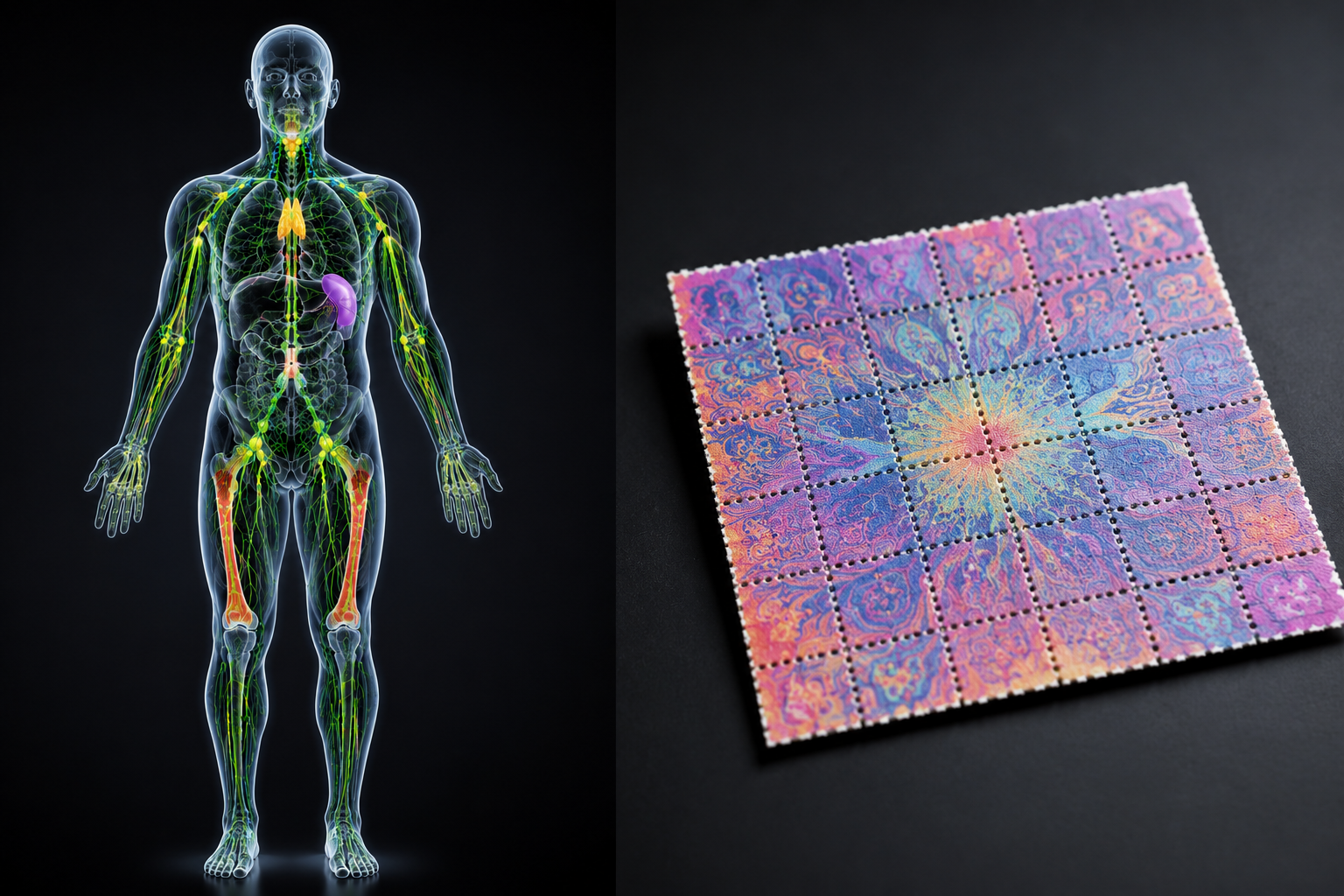
For decades, almost everything interesting about psychedelics has been assumed to happen in the brain.
LSD and psilocybin alter consciousness by interacting with serotonin receptors, particularly the 5-HT2A receptor. That mechanism has become central to attempts to understand their potential effects on depression, addiction, PTSD and other psychiatric conditions.
But serotonin receptors aren’t confined to the brain. They’re distributed throughout the body, including the gut. And a remarkable new study published in Cell suggests that activating them outside the brain could help the immune system fight cancer.
Even more intriguingly, this isn’t the first recent study pointing towards psychedelic biology occurring far beyond conscious experience. Over the past year, researchers have linked psychedelics with cellular ageing, immune signalling and now anti-tumour immunity.
Together, they raise an intriguing question:
What if we’ve been looking for the effects of psychedelics almost exclusively in the brain, when some of their most interesting biology may be happening throughout the rest of the body?
LSD Suppressed Colorectal Cancer Growth
In the new study, Targeting peripheral 5-HT2AR enhances antitumor immunity in colorectal cancer, YaTing Wen and colleagues investigated if LSD could directly influence cancer progression.
Psychedelics have a surprisingly long history in oncology. Beginning in the 1960s, LSD and later psilocybin were investigated as treatments for the enormous psychological burden that can accompany terminal illness. More recently, clinical trials have suggested psychedelic-assisted therapy may help some cancer patients struggling with depression, anxiety and existential distress. But those studies have generally treated the psychedelic as a treatment for the mind of the cancer patient, rather than the cancer itself.
To investigate, Wen and colleagues implanted colorectal cancer cells into the colons of mice and administered LSD. They found that a single dose produced a modest reduction in tumour volume and weight. But repeated LSD administration (0.15 mg/kg once daily for ten days) produced a much stronger suppression of tumour progression.
The researchers then began investigating why, and their experiments pointed toward the 5-HT2A receptor, the same serotonin receptor largely responsible for LSD’s psychedelic effects.
LSD Was Recruiting the Immune System
The anti-tumour effect appeared to depend on CD8+ T cells. These are some of the immune system’s most important cancer-fighting cells. They can recognize abnormal cells and kill them before they spread.
Cancer, however, is extraordinarily good at manipulating its surroundings to avoid immune destruction. Some tumours prevent T cells from entering. Others suppress their activity once they arrive. But LSD appeared to alter this relationship.
Activation of 5-HT2A receptors increased CD8+ T-cell anti-tumour activity, helping the immune system attack the colorectal tumours. That presented the researchers with an interesting possibility. If 5-HT2A activation was responsible for the effect, did LSD actually need to enter the brain at all?
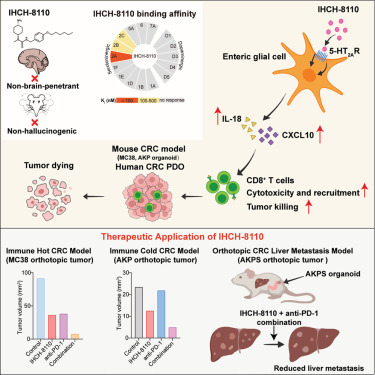
To answer that question, the researchers developed an experimental compound called IHCH-8110. Like LSD, IHCH-8110 activates 5-HT2A receptors. Unlike LSD, it was designed not to penetrate the blood-brain barrier.The researchers could therefore activate peripheral 5-HT2A receptors while largely avoiding activation of those responsible for psychedelic effects in the brain. And remarkably, the anti-cancer effect remained.
IHCH-8110 suppressed colorectal cancer progression without needing to produce a psychedelic experience.
The researchers had effectively taken:
LSD → identified the biological target → removed the trip → retained the anti-tumour mechanism.
But where exactly was that mechanism coming from?
The Gut’s “Second Brain” Was Talking to the Immune System
Embedded throughout your gastrointestinal tract is an enormous network known as the enteric nervous system. Sometimes nicknamed the “second brain”, it contains hundreds of millions of neurons alongside supporting cells called enteric glial cells.
The researchers discovered that 5-HT2A receptors on these glial cells were central to IHCH-8110’s effects. Activating them increased the production of two immune signalling molecules: CXCL10 and IL-18.
CXCL10 helps recruit CD8+ T cells into the tumour environment, while IL-18 helps promote their anti-tumour activity. The researchers had therefore uncovered a remarkable biological chain:
5-HT2A activation → enteric glial cells → increased CXCL10 + IL-18 → recruitment and activation of CD8+ T cells → increased tumour killing.
In other words, activating a serotonin receptor associated with the gut nervous system appeared capable of changing immune behaviour inside a tumour. It suggests a previously underappreciated bridge between three enormous biological systems: the nervous system, the immune system and cancer.
Making “Cold” Tumours Hot
This becomes particularly important when you consider one of the biggest problems facing cancer immunotherapy.
Drugs known as immune checkpoint inhibitors, including PD-1 blockers, have transformed treatment for certain cancers. Instead of directly killing cancer cells, these drugs essentially release molecular brakes preventing T cells from attacking them. But they don’t work equally well across cancers.
Some colorectal cancers are described as “immune cold” because relatively few active immune cells have infiltrated the tumour. Taking the brakes off T cells isn’t particularly useful if there aren’t enough T cells there to begin with. IHCH-8110 appeared capable of changing this.
By increasing the recruitment and activity of CD8+ T cells, the experimental drug made immune-cold colorectal cancers more immunologically responsive. When researchers combined IHCH-8110 with anti-PD-1 therapy, the combination produced stronger tumour suppression.
They also tested the approach across multiple experimental systems, including mouse colorectal cancer models, patient-derived human colorectal cancer organoids and a liver-metastasis model. In the latter, combining IHCH-8110 with anti-PD-1 treatment was associated with reduced liver metastasis.
It’s an intriguing potential strategy. Don’t attack the cancer directly. Change its immune environment so the body’s existing defences, and existing immunotherapies, can attack it more effectively.
And This Isn’t the Only Psychedelic Study Pointing Toward the Immune System
Just weeks before the Cell paper, another study published in Molecular Psychiatry provided a seemingly unrelated piece of the puzzle.
Researchers investigated the molecular effects of several rapid-acting antidepressants, including ketamine, LSD and psilocybin. Despite initially acting through very different receptors, the drugs produced overlapping downstream changes involving immune-related signalling pathways. The researchers described this as “convergent neuroimmune signalling.”
Among the pathways identified were immune signalling molecules including IL-15 and MCP-1, while immune changes were also associated with antidepressant response in people receiving ketamine.
The important implication is that the therapeutic biology of psychedelics may not be purely neuronal. Changes involving communication between neurons and the immune system could potentially contribute to their effects.
That doesn’t mean we’ve discovered that “psychedelics treat depression through the immune system.” The psychedelic experiments included important cellular work rather than clinical psychedelic administration, and considerably more research is needed. But combined with the new cancer study, immune signalling starts becoming difficult to ignore.
Then There’s the Psilocybin Longevity Study
And there’s another intriguing clue. In 2025, researchers associated with Emory University published a study in npj Aging investigating if psilocybin could influence cellular ageing.
Rather than studying neurons, the researchers exposed human lung and skin cells to psilocin, the active metabolite produced when the body processes psilocybin. And the results were pretty remarkable.
Psilocin treatment extended the replicative lifespan of these human cells by up to 57% under the study conditions. The researchers also reported changes involving oxidative stress, DNA-damage responses and telomere preservation.
They then moved into animals. When aged mice received intermittent psilocybin treatment over ten months, the treated animals showed better survival than untreated controls.
Again, this wasn’t primarily a story about altered consciousness. It was evidence that a psychedelic compound could produce measurable biological effects at the level of cells and tissues outside the brain.
And the study’s senior author, Louise Hecker, pointed towards an obvious but often overlooked explanation: serotonin receptors are distributed throughout the human body.
Psychedelics May Be More Than “Brain Drugs”
Put these three studies together and an interesting pattern begins to emerge. In the ageing study, psilocin influenced cellular stress and ageing pathways and extended the lifespan of human cells under laboratory conditions. In the antidepressant study, LSD, psilocybin and ketamine appeared to converge on overlapping neuroimmune signalling pathways. And now, in colorectal cancer, researchers have shown that activating 5-HT2A receptors on glial cells in the gut can trigger immune signalling, recruit cancer-killing CD8+ T cells and ultimately suppress tumour growth in preclinical models.
These are very different experiments investigating very different biological questions, so we should be careful not to assume they reveal a single unified psychedelic mechanism. They don’t. But collectively, they challenge an assumption that has dominated psychedelic science for decades: that the most important effects of these molecules necessarily happen inside the brain.
Perhaps psychedelics are better understood as compounds that interact with biological signalling systems distributed throughout the entire body. Their extraordinary effects on consciousness may be one spectacular manifestation of that interaction, but increasingly, it looks like it might not be the only important one.
No, This Doesn’t Mean LSD Cures Cancer
There is, however, an important reality check. Nobody has demonstrated that taking LSD can treat colorectal cancer in humans. The new Cell research is preclinical, with much of the evidence coming from mouse cancer models and other experimental systems, while IHCH-8110 remains an experimental compound. Likewise, the psilocybin ageing study does not show that taking mushrooms extends human lifespan, and the neuroimmune research does not establish that immune signalling explains all of psychedelics’ antidepressant effects.
These are early clues rather than clinical conclusions, but they are fascinating ones. For decades, psychedelic science has understandably been captivated by what these substances do to consciousness.
Now researchers are beginning to ask a much broader question: what are they doing to the rest of us? If this new generation of research is any indication, the answer could turn out to be considerably stranger, and potentially more medically important, than we realized.
Studies: Wen et al., Cell (2026), Targeting peripheral 5-HT2AR enhances antitumor immunity in colorectal cancer. Read the Cell study · Molecular Psychiatry (2026), Convergent neuroimmune signaling underlying rapid antidepressant response to ketamine and psychedelics. Read the study · npj Aging (2025), psilocybin/psilocin cellular ageing and mouse survival study. Read the study
Keep up with the research here.