
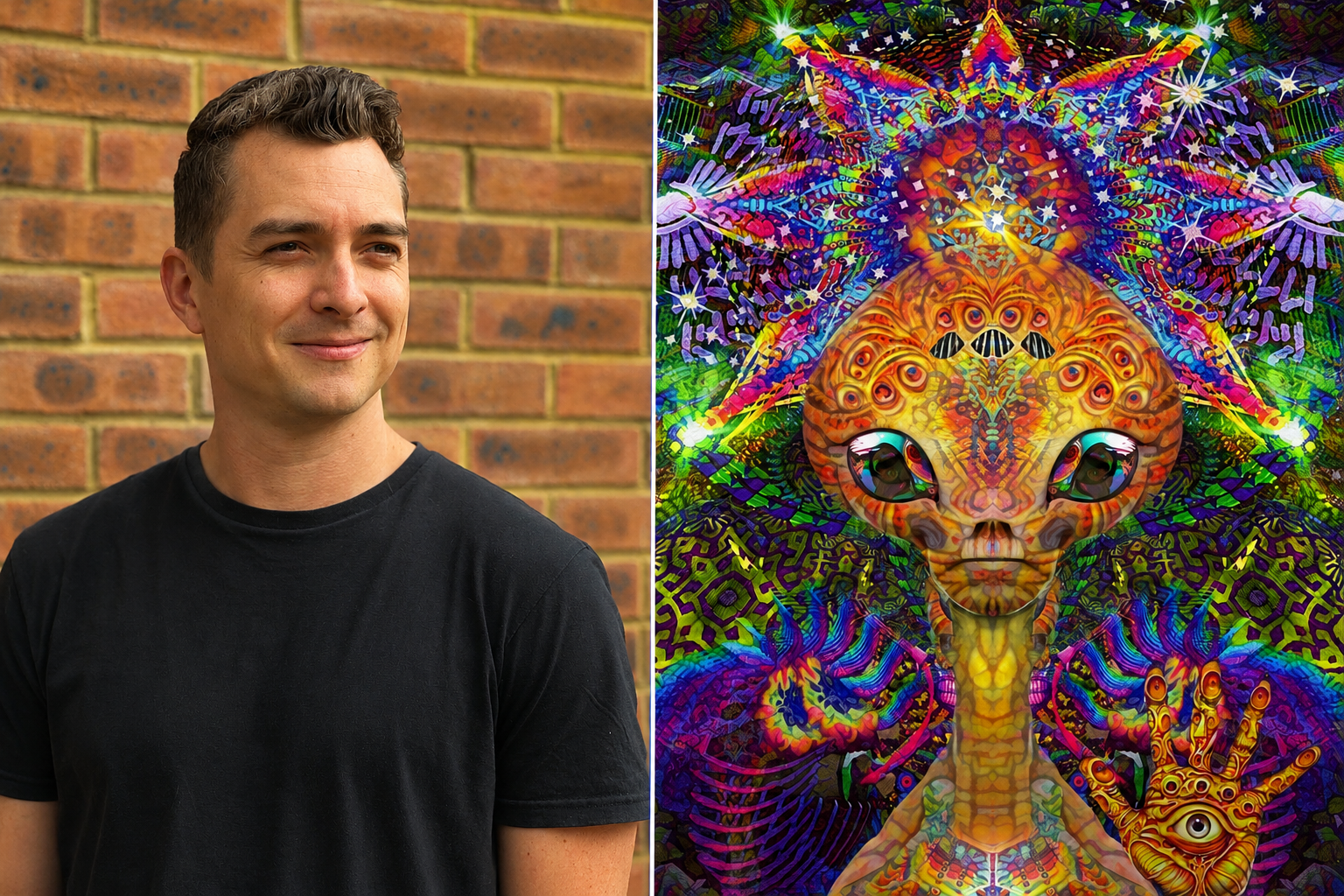
Most psychedelic research asks a narrow question: does this molecule reduce symptoms. The DMTX trial, an extended-state intravenous DMT study, asked something stranger. What happens if you take the most intense altered state available to humans and simply hold someone inside it. Not the usual ten-minute flash, but a sustained plateau, engineered through a steady drip after an initial loading dose.
Alexander Beiner was one of nine people who went through it, and his account, given on Paige Leacey’s YouTube channel, is one of the more useful first-person reports to come out of this line of research.
What DMTX actually is
The mechanics are straightforward. A bolus dose pushes the participant over threshold in two or three seconds, then a maintenance infusion holds them at peak for as long as the protocol allows. Beiner describes the onset as close to instant, comparable to the leading edge of an ayahuasca peak but compressed into a few heartbeats. The researchers were dose-finding, which is why they wanted experienced volunteers in the room. They needed people who could stay coherent enough, even at the furthest edge of consciousness, to report back something usable.
The study design assumes that subjective report, however strange, is data. That assumption matters more than it sounds, and it comes back later in the conversation.
Curiosity is a nervous system skill
Asked about “surrender,” a word that gets thrown around in integration circles, Beiner reframes it through Stephen Porges’ polyvagal theory. There’s an exploratory mode, the one that’s scanning for the next berry bush, and there’s a survival mode, the one that switches on when a tiger appears.
Most of what people call surrender is actually a deliberate shift back into the exploratory mode while something difficult is happening. He calls it curiosity hacking: noticing anger, fear, or confusion and getting interested in it rather than narrating it as good or bad.
He’s also direct about the limits of “lean in and surrender” as a universal instruction. Drawing on trauma-informed and somatic training, he describes working at the edge of a window of tolerance, going slightly past it, then returning to a resourced baseline before pushing again. Bill Richards’ old line, “go deeper into it,” works for some people in some moments. It is not a rule. Sometimes the right move is to open your eyes and breathe.
The broader point is that no single practice does all the work. Meditation builds concentration but rarely surfaces blind spots, since most Western practice happens without a community to reflect them back. Breathwork processes material the conscious mind can’t narrate. Relationships supply honest feedback. He calls this an ecology of practices, borrowed from cognitive scientist John Vervaeke, and it’s a useful corrective to the current tendency to find one modality and treat it as a complete system.
The intimacy lesson that took years
One thread of his DMTX experience concerned his relationship at the time, and through it, his relationship with women and with himself. He’s careful to note that the insight didn’t arrive fully formed in the session. It surfaced over years, alongside therapy and group work, which is consistent with how a lot of practitioners describe ayahuasca and DMT integration: the molecule opens something, but the meaning gets assembled later, slowly, often retroactively.
The conclusion he landed on is simple enough to undersell: depth of intimacy with another person tracks depth of intimacy with yourself. The harder part is the discernment required to know which tool, of all the available tools, will actually get you there in a given moment.
He cites George Bonanno’s research on trauma recovery, where cognitive flexibility, the willingness to try something, drop it, and try something else, is the strongest predictor of how well people heal. Not the specific modality. The flexibility itself.
Idealism, materialism, panpsychism
Idealism, the position associated with Bernardo Kastrup and historically with George Berkeley, holds that mind is primary and matter is the secondary appearance of it. Materialism, the dominant Western default for roughly four centuries, holds the reverse: brain generates mind, and the felt quality of experience is essentially incidental. Panpsychism, where Beiner places himself, treats mind and matter as the same substance, mutually arising rather than one producing the other. On this view the brain isn’t generating consciousness from nothing, it’s structuring and receiving something that is already a basic feature of reality.
He connects this directly to the research methodology problem. After a DMT session, participants get an iPad with a 0 to 10 scale: how connected did you feel to the universe. That qualitative experience gets quantified, then the resulting numbers get treated as more real than the experience that produced them. He’s highlighting the issue where the measurement replaces the thing being measured as the source of authority, even though the measurement only exists because someone had the experience first.
This is a useful lens for anyone reading psychedelic neuroscience papers. The brain scan is not more true than the trip. It’s a different, much narrower kind of evidence about the same event.
The unconscious, and whether you can actually change it
Beiner holds a fairly classical Jungian position, including belief in a collective unconscious. The more interesting part of this section is his answer to a harder question: can you deliberately change unconscious material, given that any attempt to do so necessarily runs through conscious awareness.
His answer, after circling it a few times, lands on a two-stage model. Altered states (psychedelic, dream, breathwork) let unconscious material surface. Then something like cognitive behavioural work, applied afterward in ordinary waking consciousness, does the actual reprogramming. The two need each other. Depth work without integration just generates experiences. Integration without depth work has nothing to work on. He flags breathwork specifically as the practice where resolution happens without a story attached, somatic processing that resolves something that never gets cognitively named, which is an interesting counterpoint to the more narrative, insight-driven model that dominates psychedelic integration discourse.
Entities
Terence McKenna’s old taxonomy for DMT entities gets a direct airing: they could be semi-physical but elusive beings (his Bigfoot analogy), projections of the unconscious, or autonomous non-physical beings with their own independent existence somewhere else.
Beiner’s actual position is more interesting than picking one of the three. He argues the entities are likely autonomous, but that the form they take is shaped by the perceiver’s framework, not invented by it. He cites parapsychologist David Luke’s observation that UFO descriptions tracked the aesthetics of human technology, nuts and bolts in the 1950s, chrome and sleek by now, as evidence that something is being filtered through cultural expectation even if the underlying phenomenon isn’t generated by it.
He pulls in Irish fairy lore as a structurally identical phenomenon. Small humanoid beings, slightly wrong proportions, encountered mostly at dusk, mostly in isolated places, with consistent reports of time distortion (going in for what feels like minutes and coming out days later) and a recurring interbreeding motif that maps closely onto modern abduction reports. His point isn’t that fairies are real in some literal sense. It’s that dismissing the entire category as “brain noise” requires ignoring a remarkably consistent cross-cultural pattern that long predates psychedelics or UFO culture.
He also makes a sharper observation about why Western frameworks default to “these beings must come from elsewhere.” Since the Bronze Age collapse, most major religious traditions, Christianity, Buddhism, Judaism, Islam, in different ways, encode the idea that ordinary material reality is not the real reality, and that what’s truly real exists somewhere else, accessible only through transcendence, revelation, or death.
Beiner contrasts this with a perspectivist framework found in some South American indigenous cosmologies and in older Celtic tradition, where entities aren’t elsewhere at all, they’re here, all the time, and the issue is that most people aren’t tuned to perceive them. No metaphysical elsewhere required, just a different bandwidth.
Where this leaves things
Nothing in this conversation resolves cleanly, and that’s the most honest thing about it. Beiner holds panpsychism as a working position, not a proof. He thinks entities are probably autonomous but filtered through perception. He thinks the unconscious can be worked with but not directly accessed. He’s suspicious of any framework, including his own, that gets too popular too fast.
What he’s modelling is a way of holding extreme experience without either dissolving it into “just neurons” or inflating it into unquestionable revelation. Given how often psychedelic discourse collapses into one of those two failure modes, that middle position is worth more attention than it usually gets.
Source: Alexander Beiner interviewed by Paige Leacey, YouTube


The video about the DMTx trial is a con. It has zero information or conversation about the alleged trial. Did it even happen?
it’s not a con. here is the published paper: https://pubmed.ncbi.nlm.nih.gov/37897244/
Absolutely not a con. It was an official documented study. Plus Alexander Beiner is pretty renowed in the space, kind of like James W Jesso
only neither the article or video provide any actual details on the trip experience
come on