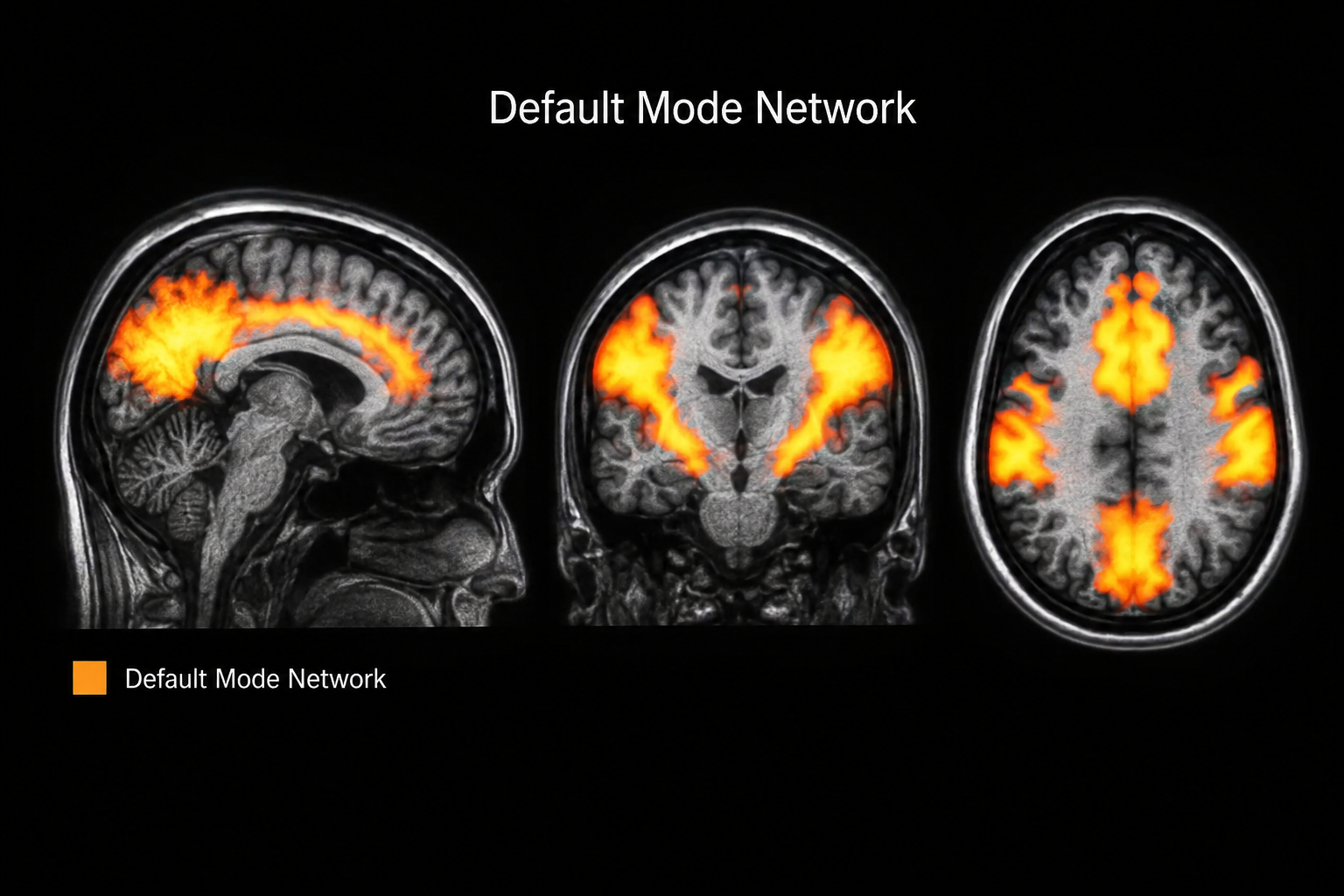
For years, the default mode network has been cast as the enemy of inner peace, the seat of ego, rumination, and the chattering “me” that meditation and psychedelics are supposed to dissolve. A new essay from Scott Barry Kaufman – a cognitive scientist, author – in Psychology Today pushes back hard on the framing of the DMN as the villain.
The case for the defense
The default mode network activates when attention turns inward, away from external tasks and toward memory, imagination, and reflection. The author, who has spent a career studying positive-constructive daydreaming (the playful, future-oriented mental wandering that fuels creativity and insight), prefers to call it the Imagination Network instead. Its job description, on this account, includes building autobiographical memory, running mental simulations of future goals, supporting empathy and perspective-taking, and incubating creative ideas.
None of that sounds like a system worth suppressing. In fact, it’s the machinery of selfhood itself, and, crucially, the machinery of connecting with other people.
So why does it get blamed?
The network also hosts rumination, the looping, self-critical thought spirals that make people miserable. But the essay points out that rumination isn’t really mind-wandering at all. A ruminating mind isn’t roaming. Rather, it’s stuck, circling the same groove over and over.
The famous finding that “a wandering mind is an unhappy mind” turns out to depend heavily on what kind of wandering is happening. Spontaneous, negative, involuntary looping drags mood down. Deliberate, forward-looking, playful drifting does the opposite.
In other words, mind wandering isn’t the issue. It’s getting trapped in negative wandering that is the problem.
The Michael Pollan contradiction
One of the sharper moments in the piece takes aim at the popular Michael Pollan book How to Change Your Mind. Pollan spends most of the book treating the default mode network as an ego to be dismantled, culminating in a scene where he straps on EEG equipment in a lab to suppress activity in a major hub of that network. Then, in the epilogue, he describes being flooded with usable ideas, images, and metaphors, calling it one of the great gifts of the whole journey.
That gift, the author points out, is positive-constructive daydreaming. It’s the Imagination Network (the DMN) doing exactly what it does best. Four hundred pages spent demonizing the system, followed by an ending that marvels at its output.
Ego dissolution
This has relevance for how the psychedelic and mindfulness communities talk about “dissolving the self.” The essay makes a distinction that a strong sense of self is not the same thing as a strong ego. Meditation, and by extension psychedelic work, doesn’t have to mean deleting or dissolving the imagination network. It can mean tuning it, calming the self-critical and ruminative parts while leaving the imaginative, connective, exploratory parts fully intact.
The author’s own research points toward integration rather than suppression. Creative cognition seems to depend on strong coupling between the brain’s executive attention network and the Imagination Network, not on shutting the latter down. Recent work on so-called control-default hubs suggests these regions act as an integrative core for complex thought and creative output.
The takeaway
Push the “no-self” framing to its logical endpoint and you don’t end up with a sage. You end up with something closer to a zombie, with no inner narrative, no imagination, no sense of a future self, and no memory of what matters. So the goal isn’t a mind free of thought. Instead, it’s a mind free enough to move between focus and imagination as the moment calls for it. A flexible, agile and adaptive mind.
The mind and mycelium both thrive through networked connection rather than top-down control. It’s a reminder that the aim of psilocybin-assisted work, or any inner exploration, is not to burn down the self. It’s to loosen its grip so it can grow.
Source: The Imagination Network Is Not the Villain by Scott Barry Kaufman, published in Psychology Today
Keep up with the research here.