For thousands of years, humans have found mind-altering compounds the hard way. They boiled woody vines, scraped bitter bark, milked toad glands, and in one particularly committed episode of early pharmacology, drank the urine of reindeer that had eaten psychedelic fungi.
That trial-and-error process gave us a small collection of extraordinary compounds: psilocybin, DMT, mescaline, ibogaine. Molecules capable of dissolving the ego, reframing trauma, interrupting addiction, and producing what many describe as the most meaningful experiences of their lives.
Now, with psychedelic research entering the mainstream, scientists are asking a question that doesn’t sit right with everyone: can we do better than what nature accidentally gave us?
The answer, depending on who you ask, is either an enthusiastic yes or a cautious probably-not-the-point.
A recent piece in The Atlantic (“The New Science of Psychedelic Drugs”) talked to the people trying to answer that question, and the debate it captures is one worth exploring.
The Case for Going Synthetic
The pro-engineering argument starts with the observation that nature isn’t optimising for your healing. Evolution doesn’t care about human therapeutic outcomes. These compounds exist because they gave their host organisms some survival advantage. That they happen to do remarkable things to the human nervous system is, from nature’s perspective, a coincidence.
Take ibogaine. A single dose can interrupt opioid dependence in ways that last months, which is something no conventional medication reliably achieves. That’s extraordinary. But ibogaine is also hard on the heart. People have died during sessions from cardiac events. The gap between “enough to work” and “dangerous for the heart” is narrow enough that its clinical use remains limited.
Researchers are asking if the therapeutic effects and the cardiac risk actually inseparable? Unfortunately, the early answer appears to be no. But scientists have developed ibogaine analogues in the lab that seem to preserve the anti-addiction properties while reducing the cardiovascular stress. None have reached clinical trials yet, but the proof of concept is there.
Psilocybin presents a different version of the same argument. It’s essentially non-toxic and there are no recorded fatal overdoses. But a standard dose is six to eight hours of intense psychological experience that can, even in carefully controlled settings with screened participants and trained guides, tip into psychosis-like states of profound dissociation. Researchers at Johns Hopkins describe it as “climbing a mental mountain.” And not everyone makes it easily to the top.
Several companies are now developing faster-metabolising versions of psilocybin that compress the experience to three or four hours. One company, Reunion Neuroscience, has Phase 2 trial data from a study in women with postpartum depression showing early signs of clinical effectiveness from such a compound. Others are working on nasal sprays, injectables, and dissolvable strips for more precise dosing.
More ambitiously, a San Francisco company called Mindstate Design Labs has built a database of over 70,000 first-person trip reports, pulled from decades of recreational pharmacology records, clinical materials, and the notebooks of legendary underground chemist Alexander Shulgin. They’re using AI to map the subjective effects of hundreds of compounds to their receptor activity in the brain, with the goal of discovering entirely new molecules that can produce specific mental states like enhanced aesthetic perception or relief from anhedonia (the inability to feel pleasure).
Even in the MDMA space, researchers have reportedly synthesised a compound that produces the emotional openness and social warmth of MDMA, but at lower intensity and without the multi-day crash that recreational users know all too well. Something that, in one researcher’s description, “just kind of cruises to the end.”
The synthetic case is essentially that nature gave us a rough draft, but we can edit it.
The Case for Keeping It Natural
The counterargument doesn’t dispute the chemistry, but it does question whether the chemistry is all that matters.
Boris Heifets, an anesthesiologist and neuroscientist at Stanford, thinks the psychedelic research world is at risk of over-indexing on the molecule. In his lab, he’s found evidence that what happens before and after a session may be more therapeutically significant than the session itself. The relationship with the therapist, the preparation, the integration work afterward (what he calls the “context of care”) appear to shift outcomes in ways that no molecular tweak currently matches.
His thought experiment goes as follows. If the molecule were the main driver, then recreational users taking the same compounds at festivals would be walking away consistently transformed. But they’re not. The setting, the intention, and the relational container seem to matter enormously.
There’s also a growing body of science suggesting the natural/synthetic comparison may undersell what the mushroom actually is. Most people who’ve taken both report that the mushroom feels different. Supporting this, a study recently published in Scientific Reports identified eight compounds in Psilocybe mushrooms that can cross the blood-brain barrier, not just psilocybin. Among them are beta-carbolines that inhibit the enzyme responsible for breaking down serotonin, effectively slowing the brain’s cleanup system and leaving the active compounds working for longer.
Animal research also backs this up. A crude mushroom extract outperformed an equivalent dose of pure psilocybin at reducing anxiety-related behaviour in mice, at just one-sixth of the dose. The human research hasn’t been done yet, but it raises a fair question about what gets lost when you pull a single molecule out of a system that evolved to produce many.
And then there’s something harder to quantify. Psilocybin mushrooms, ayahuasca, peyote: these compounds come wrapped in thousands of years of cultural knowledge about how to use them, who should guide them, what preparation looks like, and how to make sense of what happens afterward. Indigenous and traditional practices didn’t arrive at these protocols by accident. They’re the accumulated wisdom of countless generations of people working carefully with powerful states of consciousness.
A synthetic compound in a clinical trial comes with a one-page information sheet and two sessions with a therapist. There’s a big difference.
Where Does That Leave Us?
The honest answer is: we don’t fully know yet.
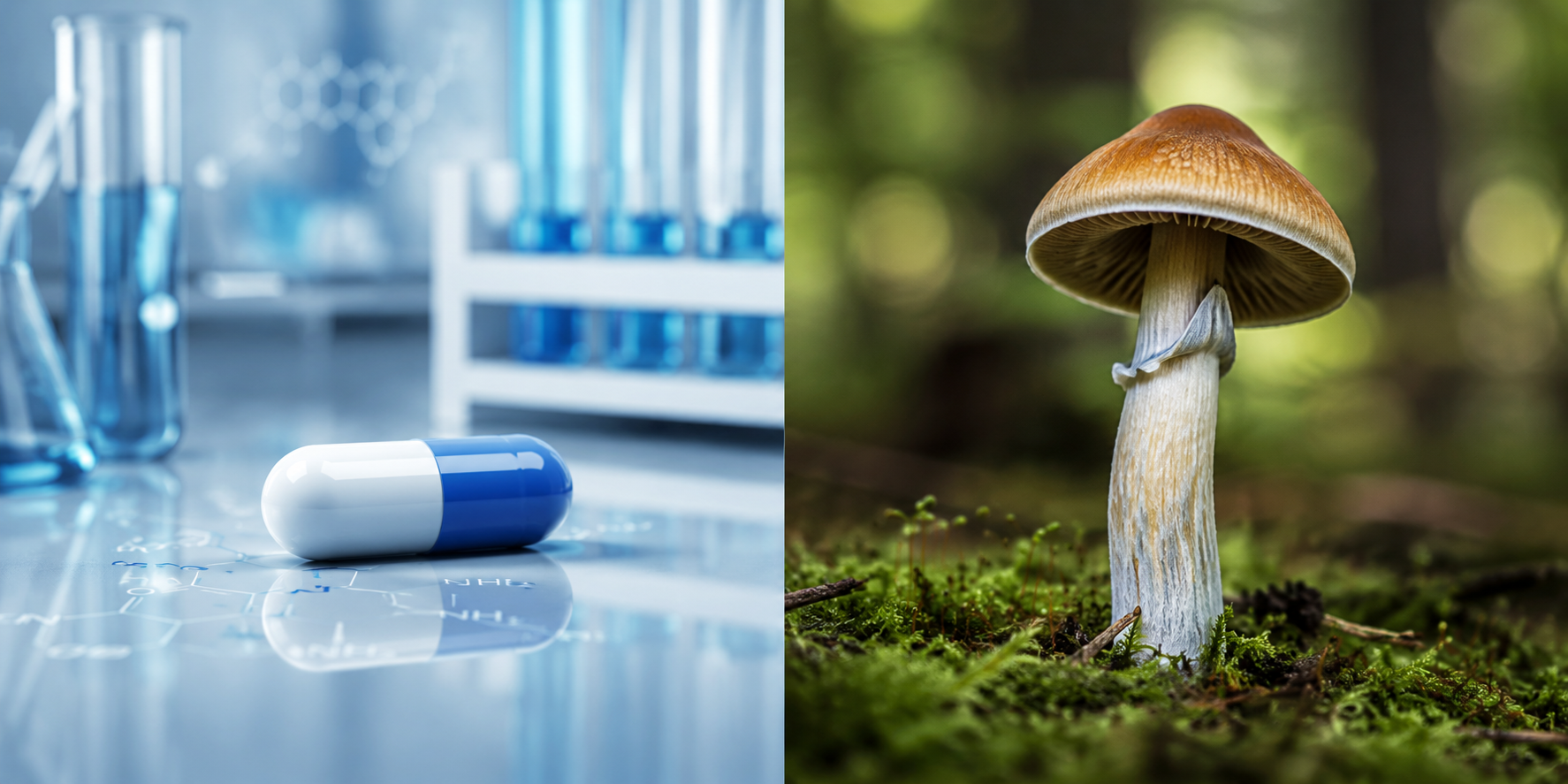
What seems clear is that neither side has the complete picture. The synthetic engineers are right that nature’s compounds aren’t automatically optimal, and that reducing harm is a legitimate goal. The traditionalists are right that the molecule is only part of the story, and that a cleaner pill isn’t automatically a better one.
The most interesting version of this field probably isn’t pharmaceutical companies replacing plant medicine. It’s researchers who take seriously both the chemistry and the context, and who are humble enough to learn from traditions that have been doing this carefully for a very long time.
Want to stay up to date on psychedelic research as it happens? The Spore Report covers the science of psychedelics, mycology, and consciousness every week. Sign up here.