
Last week, we covered a phase 2a trial showing that inhaled 5-MeO-DMT achieved 100% remission in postpartum depression patients within a single day. The results were striking. The response from readers was immediate.
Within hours, experienced 5-MeO-DMT facilitators reached out to flag concerns that hadn’t made it into the published paper. They pointed to formal complaints submitted to the UK Health Research Authority before the trial ran, centred on a specific and consequential design choice: GH Research’s trial administered a powerful psychedelic to severely depressed, potentially psychedelic-naive new mothers with limited psychological preparation beforehand and minimal integration support afterwards.
Their pitch deck had been explicit about this being a feature, not a bug, arguing that 5-MeO-DMT’s profile means treatment can proceed “without the need for lengthy and complex patient preparation” and “without the need for frequent psychological integration work after the experience.”
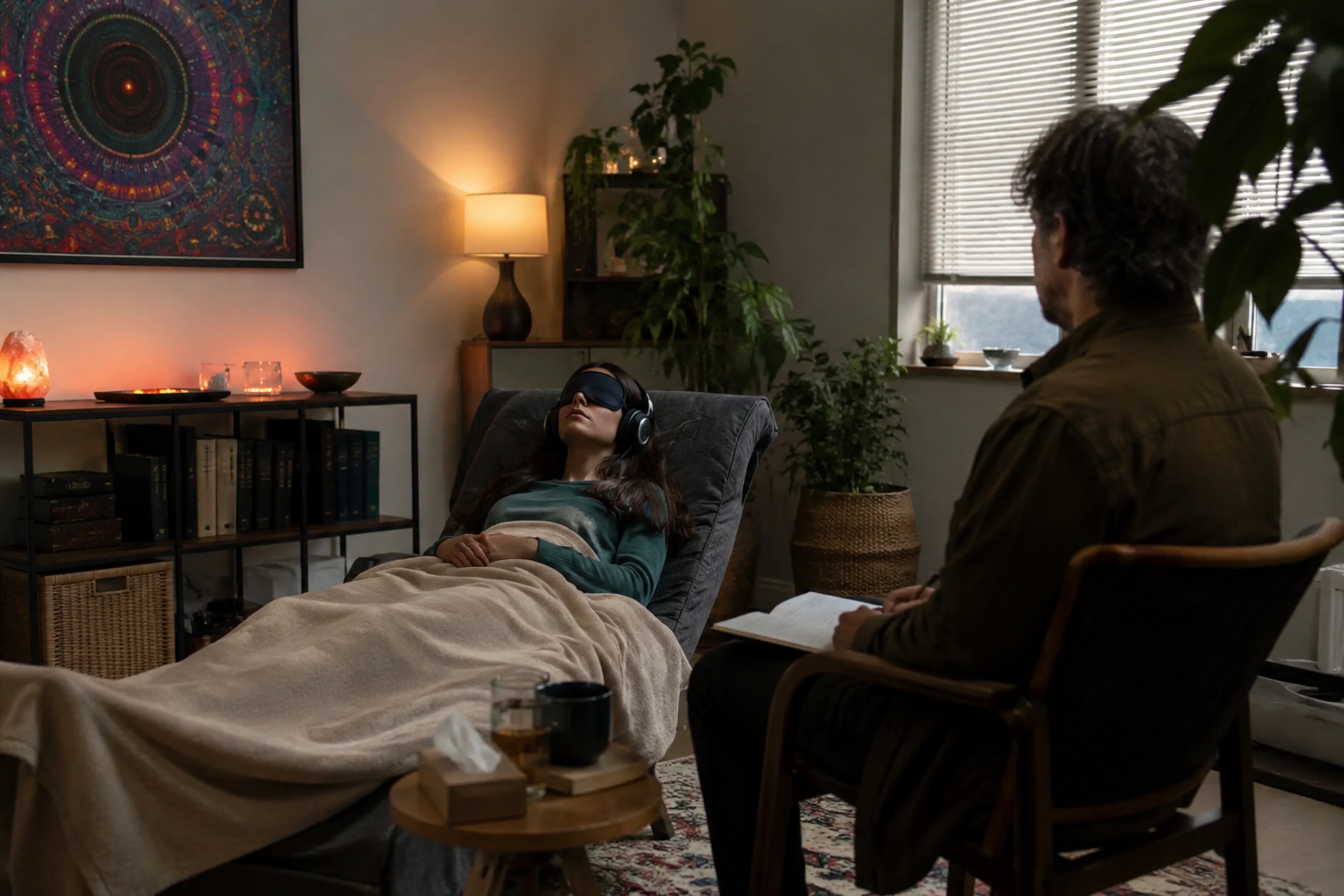
That position sits at the heart of one of the most important and unresolved debates in psychedelic medicine. How much does the therapy around the drug actually matter?
A field without consensus
The honest answer, right now, is that nobody knows for certain. A 2025 survey of forty experienced psychedelic practitioners published in the Journal of Clinical Psychiatry found substantial disagreement on almost every dimension of psychological support, from how many therapy hours should accompany treatment, to the role of spirituality, to how challenging experiences should be framed and managed.
The average respondent held only a slight preference for what the researchers called an “emotive” approach (one that emphasises the therapeutic relationship, emotional context, and meaning-making) over a “neuromodulatory” one (which treats the drug as the primary active ingredient and limits psychosocial involvement to safety monitoring). Crucially, this wasn’t a case of uniform ambivalence. It was disagreement. Many items had response ranges spanning almost the entire scale.
What the survey did reveal was that training background shapes perspective significantly. Practitioners trained through MAPS (which uses extensive therapeutic support) leaned strongly emotive. Those trained through Compass Pathways (which has advanced a more pharmacological model) leaned neuromodulatory. In other words, where you learned to do this work shapes what you think the work actually is.
This is important because, as a separate letter to the same journal put it, the data generated from drug-focused, minimal-support trials “should not be fully extrapolated to represent the safety and efficacy of psychedelic drugs administered with more extensive psychological support models.” The two approaches may be producing different interventions dressed in the same name.
What the therapy might actually be doing
A 2026 pilot trial from UCLA offers one of the clearest windows yet into this question. Researchers tested psilocybin paired specifically with cognitive behavioural therapy (PA-CBT) in sixteen adults with major depressive disorder, delivering two psilocybin doses (10mg and 25mg, one month apart) alongside twelve individual CBT sessions over four months. Thirteen of sixteen participants showed at least moderate improvement in depressive symptoms by the end of treatment, nine achieved full remission, and crucially, those improvements held at a three-month follow-up, with effect sizes (Hedges’ g = 1.9 to 2.7) that are remarkable for any depression treatment.
More interesting than the outcomes was what mediated them. Changes in depressive severity during treatment were associated with improvements in emotion regulation and shifts in cognitive schemas, the deep, often unconscious beliefs people hold about themselves and others. This suggests the CBT was providing a directed target for the neuroplastic window that psilocybin opens. The drug may loosen the architecture of the mind; the therapy helps rebuild it differently.
This maps onto a broader theoretical framework that many researchers find compelling: psychedelics don’t act on the brain the way antibiotics act on an infection, eliminating a pathogen through pharmacology alone. They appear to increase the brain’s sensitivity to context, making experience more potent in both directions. Set and setting are part of the mechanism.
The risk of getting this wrong
For most psychedelic compounds, the consequences of insufficient support are manageable. For 5-MeO-DMT, the stakes may be higher. Experienced facilitators with backgrounds running clinical trials have described the experience as involving complete dissolution of body awareness, inability to speak, and a profound conviction of dying. For a seasoned psychonaut, that can be navigable. For a severely depressed new mother who has never taken a psychedelic, it may be traumatising.
Joel Brierre, co-founder of harm reduction organisation F.I.V.E and founder of Tandava Retreats, has spoken directly about the risk of destabilisation after a 5-MeO-DMT experience, including resurfaced trauma, temporary mania, existential confusion, and in worst-case scenarios, suicidal ideation. His organisation provides a minimum of four weeks of support after sessions as core to the safety and efficacy of the work.
The Lusaris precedent adds weight to these concerns. That US biotech ran a similar no-support 5-MeO-DMT trial for depression, backed by the same private equity firm as GH Research, and has since apparently ceased operations under unexplained circumstances. The field has, largely, moved on without asking what happened.
Incentives
Pharmaceutical companies developing psychedelic treatments have clear commercial incentives to minimise the therapy component. Therapy is expensive, time-consuming, difficult to scale, and hard to patent. A drug that works without it is a far more attractive product. The neuromodulatory framing serves those interests, whether or not it serves patients.
That doesn’t make the neuromodulatory position wrong necessarily. It may be that for certain compounds, at certain doses, in certain populations, the pharmacology does most of the work. The honest position is that we don’t yet have the evidence to know. What we do know is that the trials being run to generate that evidence are often designed by companies with a financial stake in a particular answer.
The question of how much psychological support psychedelic therapy requires will determine what these treatments actually are, who can access them, what they cost, and whether they help or harm the most vulnerable people who reach for them. That conversation deserves to happen in public, with full information, before the regulatory frameworks that will shape this field for decades are locked in.
The results from the GH Research trial were remarkable. But the saftey context around them matters just as much.
Sources: Bender DA et al. J Clin Psychiatry. 2025;86(1):24m15521 | Modesto-Lowe V et al. J Clin Psychiatry. 2025;86(4):25lr15978 | Weintraub MJ et al. J Affect Disord. 2026;403:121423 | https://www.psychiatrist.com/jcp/psychedelic-therapies-one-drug-multiple-treatments-reply-modesto-lowe-et-al/
If this piece made one thing clear, it’s that the integration work is the medicine, not an afterthought. That’s exactly what AfterGrow exists for: six weeks of structured support to help you actually metabolise a psychedelic experience into lasting change.Enrollment closes Friday, June 26th, and the program starts July 1st. Join AfterGrow here.
Want more breakdowns like this one? Subscribe to The Spore Report here.

One thought on “How Important Is the Therapy in Psychedelic-Assisted Therapy? A New 5-MeO-DMT Trial Raises Questions”